
Brazilian writer Urariano Mota, who has written extensively about the years of dictatorship (1964 to 1985), reflects on its continued legacy through what is taught in the country’s military schools.
Perhaps a better title would be “The teaching of false history in Brazil’s military schools”. I mean: I think of the young people in the military colleges, ardent young men and women, having to an empty and violating history, which they call the History of Brazil – Empire and Republic, from a Marechal Trompowsky Collection, from the Army Library.
But let’s not be prejudiced: let’s illustrate what students in military schools are forced to learn: here, for example:
“In the military governments, particularly under President Médici, there was censorship of the media and the fight against and elimination of guerrillas, both urban and rural, because the preservation of public order was a necessary condition for the country’s progress.”
A brief search reveals that these books were used for teaching by the Directorate of Preparatory and Assistance Education (DEPA), created in… 1973 – yes, that unforgettable year of the Médici dictatorship itself.
And don’t think that such teaching is outside the law. It is based on a certain Article 4 of the R-69. You see? The barracks legislate. The DEPA organizes the pedagogical proposal “to guide the educational process and teaching-learning in the formation of citizens who are intellectually prepared and aware of their role in society according to the values and traditions of the Brazilian Army”. What values would these be, apart from the anti-communist ideas of the dictatorship?
The military schools indoctrinate, making a real school with a party for the right, while hiding the tragic history and life-destroying role of the rule of the military dictatorship. What democrats used to demand, namely that the military schools could no longer remain independent from Brazil, as if they were impregnable islands of civilization, continues.
What I used to receive in threatening emails in 2010, such as “Thank God that there is still teaching in the military colleges, because it is through them that the students who still think about Brazil’s universities are trained. The books used in the military colleges are those published by the Army Library, because the ones circulating in national bookstores are of a standard below acceptable and are completely distorted in terms of their content” – this type of teaching still goes on.
But I think it’s time to return to the discussion of darkness with a new criticism: there is a point at which civilian, public schools could look with interest at military schools. In other words, our civilian schools could translate the military schools in their own way, with a translation to freedom in a permanent classroom discussion. I think that public, civilian schools lack an education in the humanities, in better humanism.
Understand: this is not about including humanity in a pure curriculum. It’s about an education for life in all subjects, nothing military. We shouldn’t give people the means to ascend socially and form new consumers among the poor, reproducing the capitalist system’s idea of exclusion. We should train people with a vision of humanity. This is the ideological school that we lack, and which the military does well in its own way: training anti-communist soldiers from the Cold War era.
We mustn’t forget the hidden and justified state terrorism in military schools. It’s a terror that I recreated in my memory when I wrote the novel Never-Ending Youth. Here’s a brief excerpt from one page:
“The rings of a vile cranial garrot they called ‘Christ’s Crown’ that was screwed tighter and tighter to extract information, bones were broken and metal rods inserted in the anal canal. People who saw and suffered such things are silent. Some victims feel guilty for having survived while others perished, others are easily terrified and experience persistent, Pavlovian reflexes. Often, the reflex is conditioned by memory which does not speak so the pain will not be repeated. We understand. It is paralyzing to think about what we have known and seen. We think about things we do not want to think about and speak to ourselves about matters we dare not utter to anyone else. It is depressing and we do not want to drown in angry madness. Or to be beaten again, in silence. We want it to end.
“I want peace, to reflect in peace. But the hunted ‘terrorist’, as described by the lawyer Gardênia, comes to mind: “Vargas is lying on a table, wearing light blue underpants with one bullet wound in his forehead and another in his chest. His eyes are open, his tongue hanging out of his mouth.
“I want peace, to reflect in peace. But Vargas stands before me. I see he is terrified. He is facing the end. Vargas’ eyes come back to me in the bloody January of 1973. The mere thought of them brings a bitter taste of gall and bile to my mouth. Will I, or should I, have the refreshment of a break?”
Memories of state terrorism during the dictatorship return, memories hidden to this day in the teaching of military schools.
Urariano Mota is a writer and journalist, author of the novels Soledad no Recife (Soledad in Recife) and Never-Ending Youth, which narrate the Brazilian dictatorship.
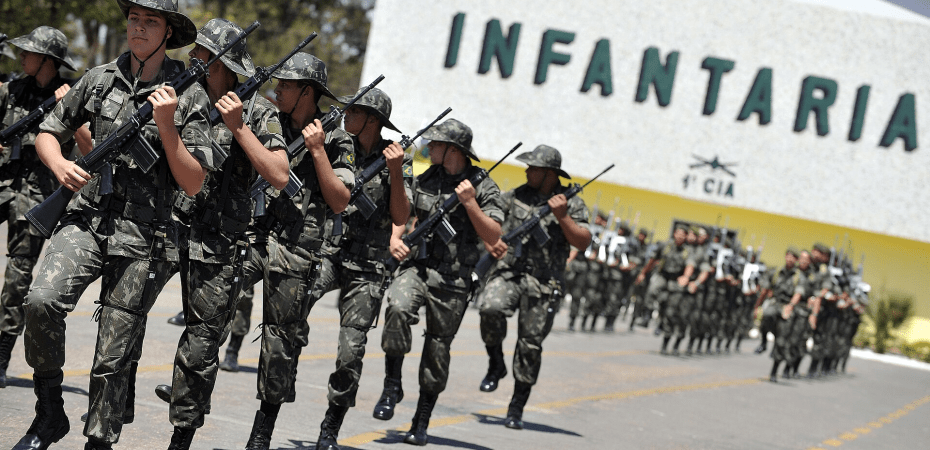
Image: Brazilian soldiers. https://commons.wikimedia.org/wiki/File:Brazilian_soldiers,_2012.jpg Foto: Felipe Barra Source: Militares desfilam na cerimônia de posse do general Vilela no Comando de Operações Terrestres (Coter) Author: Ministério da Defesa, licensed under the Creative Commons Attribution 2.0 Generic license.


[…] *Publicado em inglês no Labour Hub, do Reino Unido, aqui The coup of 1964 continues in Brazil’s military schools – Labour Hub […]