

This Saturday, 6th June, Socialism in the Suburbs and the Socialist Health Association are holding a public meeting in Waltham Cross on “Healthy Lives, Healthy Communities” (all welcome! – register on the link. More details at the bottom of this article). In advance of this event, SHA Chair Rathi Guhadasan discusses the impact of current housing policy on our health.
Home is where the health is
The UK’s housing crisis is not simply a matter of bricks and mortar — it is a public health emergency hiding in plain sight.
Decades of research — and the lived experience of millions of people across the UK — reveal a stark and urgent truth – one which those most at risk can do little or nothing to change. Where you live, and the quality of the home you live in, may do as much or more to determine your health outcomes.
In England alone, around 7.5 million people live in housing that is classified as non-decent. Millions more are trapped in overcrowded homes, insecure private rentals, or in fuel poverty — unable to adequately heat the rooms they sleep in.
These are not abstract statistics. They are the conditions in which children develop asthma, in which older adults fall and fracture bones on cold damp floors, and in which young people’s mental health quietly deteriorates. A Parliamentary Office of Science and Technology briefing estimates that 21.5% of the tens of thousands of excess winter deaths we see each year are attributable to cold homes specifically, with an estimated yearly cost to the NHS of over half a billion pounds.
The overall cost to the NHS of poor quality or insecure housing is estimated £1.4 billion per year, excluding long-term care for chronic conditions. But this is only a fraction of the wider societal costs, which include long-term care, mental health, social care and poorer educational achievement and are estimated at £18.5 billion per year.
The cold truth about damp and disease
The relationship between cold housing and respiratory illness is robustly evidenced in research. A 2023 peer-reviewed paper in the European Respiratory Society journal Breathe — co-authored by researchers from Alder Hey Children’s Hospital and the University of Liverpool — concluded that poor housing quality “negatively impacts the quality of the air that children breathe in their living environment, which is detrimental to their respiratory health” and that “urgent action is needed to improve housing quality.”Children in cold homes are more than twice as likely to suffer respiratory problems compared to those in warm homes, according to the Marmot Review Team’s analysis of the evidence.
Cold housing’s impact on the heart and circulatory system is less widely understood but equally well evidenced. The World Health Organisation note that cardiovascular diseases including stroke and heart disease are more common in cold homes, because cold exposure raises blood pressure — a known driver of cardiovascular risk. Research shows that for every 1°C drop in temperature, cardiovascular disease mortality increases by 1.6%, with positive associations found specifically for coronary heart disease, heart failure, and stroke. The English Longitudinal Study of Ageing found that 16% of older adults were living in homes below 18°C — the WHO’s recommended minimum — and that high blood pressure and increased blood viscosity in cold conditions are major causes of winter deaths from heart attacks and strokes.
And it’s not just our physical health that is affected. Prolonged cold temperatures at home can double your risk of developing new mental health conditions and triple your risk of exacerbating existing mental health problems. 28% of children living in cold homes are at risk of multiple mental health symptoms including anxiety and depression. They also face reduced educational attainment, lower self-esteem, poor nutrition, and reduced infant weight gain – energy that should be expended in growth and brain development is instead used to keep warm.
Overcrowding and the invisible mental health toll
Overcrowding — defined as more than one person per room — affects around 700,000 households in England, with disproportionate impact on Black, Asian and minority ethnic communities and low-income families in urban areas.
People in overcrowded homes report higher rates of anxiety, depression, and psychological distress. For children, the lack of a quiet space to study or decompress leads to poorer educational attainment and behavioural difficulties. For adults, there is no sanctuary from stress. The home — which ought to be a place of recovery — becomes a source of chronic strain.
Housing insecurity amplifies this further. A secure tenancy offers psychological stability; the constant threat of eviction does the opposite. A recent systematic review found that 12 out of 14 studies in OECD countries reported significant associations between unstable housing and renters’ mental health issues. While the Renters’ Rights Act marks progress, access to truly secure, affordable and healthy homes cannot come soon enough for the millions who live under that shadow.
Homelessness: the sharpest end
At the most extreme end of the housing spectrum, the health consequences become starkest. The average age of death for a person sleeping rough in the UK is just 45 years — compared to 77 years for the general population. The homeless face dramatically elevated rates of tuberculosis, cardiovascular disease, severe mental illness, and substance dependency – predictable outcomes of lives spent without shelter, warmth, or safety.
There are currently over 130,000 households in temporary accommodation in England — including more than 165,000 children. Temporary accommodation is not a neutral holding space. It is typically overcrowded, poorly maintained, and geographically disruptive. Children move schools. Adults lose jobs. Support networks fracture. Health deteriorates. The longer a household remains in temporary accommodation, the worse the outcomes become.
Health inequalities built into the system
The burden of poor housing is heaviest on those already facing structural disadvantage. People from racially marginalised communities are more likely to live in overcrowded and substandard homes. Disabled people face acute barriers to suitable and adapted housing. Those on low incomes are squeezed between rising rents and stagnant wages, forced into the least regulated corners of the housing market.
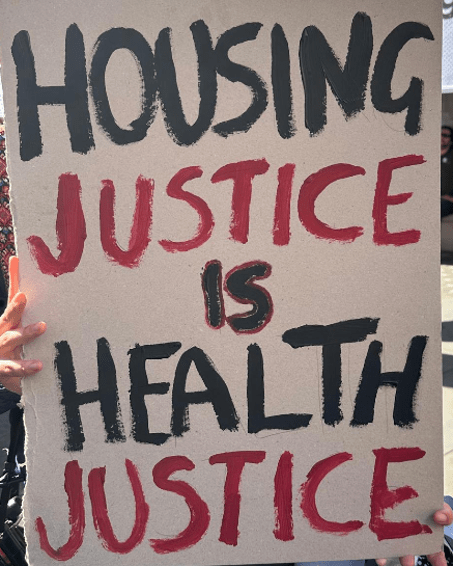
This means that housing is not merely a health issue — it is a health inequalities issue. The gap in healthy life expectancy between the most and least deprived areas of England already stands at almost 20 years. Housing conditions are a significant driver of that gap. Any serious commitment to reducing health inequalities must therefore be a commitment to improving housing.
Labour’s housing policy scorecard
| Renters’ Rights Act – no fault eviction ban | Delivered |
| Awaab’s Law – social housing | Delivered |
| Awaab’s Law – private rented housing | Delayed |
| 1.5 million affordable homes | Off track |
| Warm Homes Plan / retrofitting | Slow Start |
| Temporary accommodation – children | Crisis unresolved |
| Local Housing Allowance | Frozen again |
| Housing as a health priority | No framework |
Some good progress has been made under this Labour government. The Renters’ Rights Act represents a meaningful step forward for the 11 million people in England’s private rented sector. Awaab’s Law — named for the two-year-old who died in a Rochdale housing association flat in 2020 from severe respiratory disease caused by mould — came into force for social landlords in October 2025. For families trapped in cold, damp homes, it is a legally enforceable right to a habitable home. However, currently this will not be extended to the private rented sector until 2027 at the earliest.
But Labour’s flagship promise — 1.5 million new homes in five years — is in serious trouble. Only 208,600 additional dwellings were delivered in 2024–25, a 6% decrease from the previous year. Forecasts predict that Labour will miss its target by anything from 100,000 home to 50%.
Part of the problem is structural. The construction sector faces a massive shortage of bricklayers and tens of thousands of other skilled workers. The other problem is affordable housing in particular. In a troubling sign of priorities, the government agreed to slash affordable housing requirements from 35% to potentially just 20% for London developers, to unblock stalled projects. When quantity is chased at the expense of affordability and tenure mix, it is invariably those on the lowest incomes — those whose health is most damaged by poor housing — who lose out.
One of the most significant — and least discussed — failures of Labour’s housing policy is its approach to housing benefit. The previous Conservative governments systematically cut Local Housing Allowance, leaving a widening chasm between what benefits cover and what private landlords charge. Labour uplifted LHA in 2024 – a welcome move. But in 2025 it was frozen again – probably until 2027, leaving families unable to afford rents in their local area, facing homelessness, forced into overcrowded accommodation, and experiencing the predictable cascade of health harms that follows. For many, this is exacerbated by the household benefit cap – a Conservative-Lib Dem invention that Labour has chosen to maintain.
Labour’s £15 billion Warm Homes Plan is a welcome health intervention. Cold homes kill. Yet the rollout has been slow and the programme’s ultimate reach and speed remain uncertain. And delay here means thousands of preventable deaths each year.
Finally, housing should be embedded into the NHS’s prevention agenda — with routine screening for housing risk, and cross-departmental accountability for the health outcomes of housing policy. The voices of those most affected — people in overcrowded flats, in mouldy bedsits, in temporary accommodation — must be at the heart of housing reform, not an afterthought.
The call for a joined-up housing and health strategy is not new — it is, in fact, a return to first principles. When Aneurin Bevan created the NHS in 1948, he did so as Minister of Health in a department that also held responsibility for housing, embodying the postwar conviction that a decent home and a healthy life were not separate ambitions but a single one.
The evidence is clear. A home that is warm, secure, and free from hazard is not a luxury — it is a precondition for good health. Until housing policy is treated as health policy, we will continue to pay the price: in suffering, in inequality, and in the billions spent treating conditions that better homes would have prevented.
Come and join us on June 6th and get involved! There are a range of interactive sessions on housing and other issues affecting our health and how we can respond in our communities.
Register here.
Free entrance, all welcome! Easily accessible by public transport.

Dr Rathi Guhadasan is Chair of the Socialist Health Association.

