
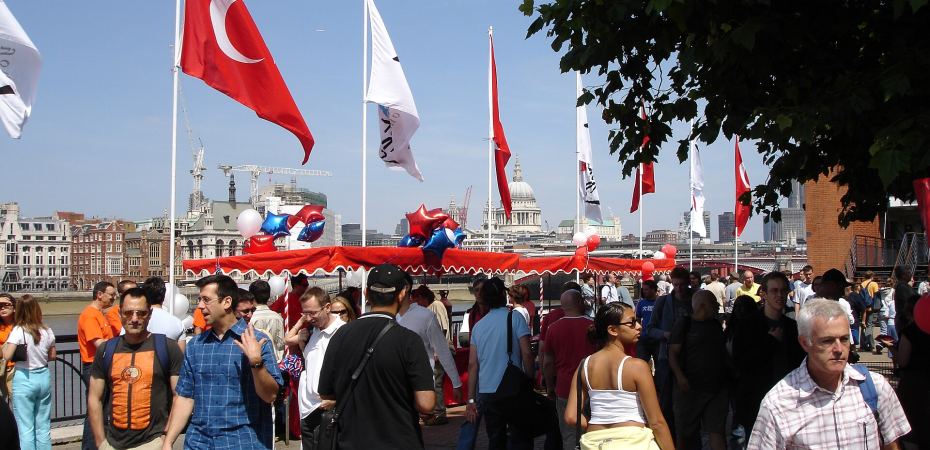
George Nicholson, who passed away earlier this year, played a crucial role, as Chair of the GLC’s Planning Committee, in the creation of the Coin Street community development on London’s south bank, as this tribute from fellow councillor Michael Ward explains.
From Coin Street, you can see across the Thames to the City, and the dome of St Paul’s, designed by Christopher Wren.
The inscription on Wren’s monument in St Paul’s reads: “If you seek his monument, look around you…”
That could be George Nicholson’s epitaph: look around you.
Look first at Coin Street, the riverside walk, Borough Market and more. George had the vision, the commitment, the determination, and the staying power, to make all this happen.
Now look at what happened beyond Coin Street: from Putney Bridge to the Thames Barrier, the banks of the river are dominated by an unrelenting cliff wall of luxury apartments, with very little social or affordable housing. Coin Street was and is different.
Coin Street is a monument to what could have been. What should have been.
In the 1960s and 1970s, London’s old wharves, and riverside industries, were declining. Along the river, community groups campaigned for local jobs, affordable housing and open space on the newly vacant sites.
I remember the planning inquiries for the Morgan Crucible site in Battersea, and for Hays Wharf, near here. It was at one of those inquiries (I think the second Morgan Crucible enquiry, in January 1978) that I first met George, who had come to support the local objectors. I was giving evidence on behalf of the Battersea Labour Party.
Coin Street triumphed, where most of the other campaigns did not. This was for two reasons:
- The sustained local community leadership – not just George, but others – the late Ted Bowman, Iain Tuckett who is still here – and many others, who worked through a network of local organisations – Coin Street Community Builders, Waterloo Community Development Group, the Association of Waterloo Groups, and many more. Plenty of community organisations expire after five or ten years – Coin Street has lasted over fifty.
- The existence of a strategic London authority with sufficient resources, sufficient autonomy, the nerve, and the political will – to commit to supporting the Coin Street development.
The key Coin Street inquiry opened on 7th April 1981. The outgoing, Conservative Greater London Council administration supported an application from Greycoat, a developer, for large scale commercial development and office building.
On 7th May, just a month later, the Conservatives were defeated. George was elected the GLC member for Bermondsey, replacing the veteran Labour Leader Reg Goodwin.
Within days of the election, the instructions to the GLC lawyers representing the Council at the Coin Street Inquiry were reversed: the GLC now opposed the Greycoat application, and supported the application from community groups.
Then two things happened:
- First, after a long drawn out Inquiry, the Secretary of State, Michael Heseltine, gave consent to both applications – the Greycoat one and the community one.
- Second, although Greycoat had a valid planning consent, they only had an option to buy the site – and they needed the GLC to agree to close some of the existing streets. Time was running out on their option.
Eventually, in summer 1984, Greycoat agreed to sell the site to the GLC, and the GLC agreed to sell it on to Coin Street.
The GLC Abolition bill was going through Parliament. The government suddenly introduced a clause which prevented the GLC from selling assets below market valuation without the minister’s consent. The clause was to come into effect almost immediately.
We bought the site in July 1984, for, I think, £3.6 million. Days later, we sold it to Coin Street Community Builders for £ 1 million. The Planning Committee met immediately, and imposed a condition that the land must be used for social housing.
Sound professional advice demonstrated that the market value of the site with the new planning consent was far less than it had been before the change.
The whole of the next day George and I and other members and officers spent in County Hall hammering out the deal. That evening, we realised we needed Counsel’s Opinion to finalise the details. And we needed that opinion quickly, before the new government restrictions on selling assets came into force.
The leading local government QC instructed by the Council was out of town, conducting a planning inquiry on the borders of Essex and Suffolk.
At 8.00 at night, we commandeered the Council’s official Daimler and set off – council members and officers – to find our QC in his country house hotel.
It was after 11.00pm when we arrived: our conference with counsel took place in the hotel’s ornate lounge. When we had finished expounding our case, the barrister sat back in his armchair, and said: “Why are we here? We are here because we are up against the clock. But then, in life, there is always a clock.”
At that moment, the hotel grandfather clock struck midnight.
The conference concluded – there were some points that had to be settled before the vital written opinion could be delivered. Somewhere between 1.00 and 2.00am the car set off back to London.
Pamela Gordon, Deputy Director of Industry and Employment, kept a diary at the time. She recalls:
“On the way back, on the Colchester by-pass, the catch on the car’s bonnet broke and the bonnet kept rising and blocking the driver’s view. After a lot of failed attempts to mend it I produced a bit of string from my handbag and George, who knew about knots, used it to fix the bonnet! That bizarre incident is always part of the Coin Street saga for me.”
Dawn was breaking as we arrived back at County Hall.
Later that day the last issues were resolved. Committees met and ratified the deal.
Just to make sure, George found the machine to apply the Council’s official seal to the contract, and applied it himself.
So farewell, George. Thank you for fifty years of friendship, support and sound advice.
We shall not see your like again.
Michael Ward is a former GLC councillor, serving as Chair of its Industry and Employment committee. A member of the Labour Party since 1969, he now lives in Arundel.
Image: Coin Street Turkish Festival https://commons.wikimedia.org/wiki/File:Coin_Street_Turkish_Festival.jpg Source: originally posted to Flickr as Coin Street Turkish Festival. Author: anaru, licensed under the Creative Commons Attribution 2.0 Generic license


