

Professor Hazel Conley dispels some myths about an historic piece of industrial action.
A great deal has already been written about the Ford sewing machinists’ strike in 1968, which has become something of a cause célèbre for the left. Most of what has been written focuses, understandably, on the brave actions of Ford Dagenham women. Academic debate has agonised over whether the women were exercising class or feminist consciousness, as if these two things could be clinically bisected. While these arguments have been good at getting articles published in academic journals, they have been less good at helping us to understand why the dispute failed to get the Ford women equal pay and why, almost 60 years after the dispute, we still have thousands of equal pay cases swamping Employment Tribunals.
I would like to take a different approach. We cannot understand the true bravery of the Ford Dagenham women or learn from their fight for justice without analysing and understanding what was done to them, in concert, by their employers, trade unions and the Labour government of the day.
A myth has grown up that the dispute led to the Equal Pay Act 1970. Equal pay legislation featured as a pledge, albeit on the last page, of the 1964 Labour Party Manifesto but it was kicked into the long grass of TUC and CBI deliberations by Ray Gunter, then Minister of Labour. There it stayed until, in April 1968, Prime Minister Harold Wilson replaced Gunter with Barbara Castle.
Cabinet papers show that Castle was keen to get equal pay legislation tabled before the next General Election. The Ford Dagenham dispute, which occurred less than two months after Castle took office, was a timely photo opportunity in support of the legislation but the Cabinet papers show that future membership of the European Economic Community and the fear of how much equal pay might add to the national wage bill and increase inflation were the driving factors in shaping the Equal Pay Act.
Indeed, Castle was keen to categorise the Dagenham women’s strike as a localised grading dispute rather than equal pay. This was largely because the women wanted to compare their work with men doing different jobs. To limit the impact of the equal pay legislation, Castle had opted for a version that would only apply when women and men were doing “like or broadly similar” work or when a voluntary job evaluation put in place by the employer indicated that different jobs were of equal value. This fell below the definition of equal pay contained in the ILO Convention 100 established in1953, but it brought the expected increase in women’s wages to a level that the government felt would have the least impact. Therefore, Castle knew the impending legislation would not provide equal pay for the Ford women and instead promised them a government Inquiry into the causes of their dispute.
The Court of Inquiry was led by Sir Jack Scamp, who was appointed by Harold Wislon after being knighted earlier that year for services to industry, particularly for conciliation in difficult industrial disputes. The Inquiry examined pay restructuring at Ford and the introduction of a job evaluation scheme put in place by management consultants Urwick, Orr and Partners. Prior to the job evaluation, hourly paid women received a grade of pay lower than the most unskilled man working in the company. Following the job evaluation scheme women were present in the lowest three of the new grades but at a lower rate of pay to men in the same grade:
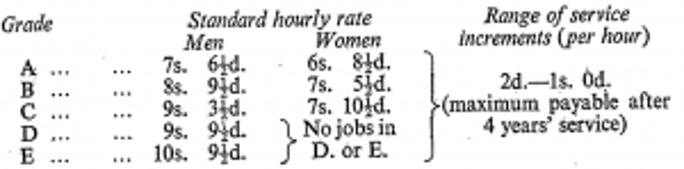
Source: Scamp Report, 1968, p.9
This pay structure was agreed by all twenty trade unions recognised by Ford at that time, which is disappointing since equal pay had been a principle accepted by the TUC since 1888.
The sewing machinists were placed into Grade B and were still paid a penny an hour less than the least skilled men working at Ford. The sewing machinists firstly took unofficial action to ban overtime and then to strike when no progress was made on their dispute. Most of the sewing machinists at the Dagenham plant were members of the National Union of Vehicle Builders (NUVB) but six were members of the Amalgamated Union of Engineering and Foundry Workers (AEF). Both unions eventually made the strike official but only the AEF claimed, somewhat belatedly, the dispute was about equal pay. The NUVB were of the same opinion as Ford management, Sir Jack Scamp and Barbara Castle, that the dispute was about grading. Following a deal brokered by Castle for the women to return to work, Ford increased the machinists’ pay from 85% of the male rate for Grade B to 92%.
The final report of the Court of Inquiry provides some interesting insights into why the Ford women failed to gain equal pay following their dispute in 1968. In their evidence to the Inquiry, the NUVB, who did not claim the dispute was about equal pay, noted:
“…there was further discrimination within Grade B itself. A male employee could enter any Grade B job in Fords without previous experience. The sewing machinist had to pass a test on three different machines—edge cutting, welting and cording. Men were required to pass a test for entry to only two jobs – Eastman cutter and production welder, both Grade C.” (p.26)
The Report highlights that the sewing machinists’ job rated higher on eight of the job evaluation factors than the Grade C leather cutters’ job and lower on five of the factors. However, each factor carried a weighting which could increase its value in the overall score. The five factors in which the leather cutters scored more must, therefore, have had weightings that boosted their score.
A crucial failing of the job evaluation process is that the weightings were kept confidential and were known only to Ford management and the consultants. In this respect the trade unions were at a major disadvantage in the process but had not contested this prior to the sewing machinists’ unofficial dispute.
A later account of the dispute (Friedman and Meredeen,1980:117-18) reported that the trade unions voted 12 to 2 not to ask the employers for the weightings of the job evaluation scheme. Ford defended its decision not to reveal the weightings by claiming that this knowledge would bias the decision-making of the job evaluation panel, although the employer representatives on the panel were aware of them. They further defended the objectivity of the weightings by claiming they had been “evolved by computer” (p.31), a dubious claim given what we now know about the potential for discrimination in computer algorithms.
The Inquiry did not challenge the lack of transparency in relation to the weightings that had resulted in the lower grading of the sewing machinists’ job. In reaching its decision, the Court of Inquiry concluded that the lower grade given to the sewing machinists was correctly arrived at, supporting the preference of Castle, Ford and most of the trade unions:
“We find that this dispute is about the grading of the sewing machinists’ job not about equal pay.” (p.44)
The sewing machinists therefore did not win pay equality in 1968, nor would they receive it in 1970, after the passing of the Equal Pay Act. In 1972 Sir Jack Scamp became the chairman of Urwick, Orr and Partners, the consultancy firm who worked for Ford in the implementation of the job analysis scheme.
The sewing machinists did not receive equal pay until 1985, after a change in the law, forced by the European Court of Justice, gave women the right to equal pay for work of equal value, which allowed them to compare their work with men doing different jobs. Even then the law did not directly make the difference since an employment tribunal failed to find in their favour. Only after another strike by the sewing machinists did Ford agree for a panel of enquiry led by ACAS to re-evaluate the sewing machinists’ jobs, this time finding unanimously that they were, indeed, worthy of a Grade C.
The most fitting tribute we can pay to the Ford sewing machinists is to emphasise their courage in the face of a powerful collaboration of vested interests to avoid equal pay and to recognise when history may be repeating itself.
For further reading ,see Friedman, H. and Meredeen, S. (1980) The Dynamics of Industrial Conflict: Lessons from Ford London: Croom Helm.
Hazel Conley is a Professor of Human Resources in the College of Business and Law at the University of the West of England, Bristol. Her research focuses on the State as employer and legislator with a focus on discrimination and inequality in the workplace, particularly in relation to pay equality and the effectiveness of legal interventions.
Hazel will be talking about the Ford Dagenham Strike on June 25th as part of a General Federation of Trade Unions course on Trade Union and Working Class History. Registration details here.
Image: https://www.kcl.ac.uk/news/discrimination-lies-behind-the-gender-pay-gap-and-we-need-to-investigate-it-further Licence: Attribution-ShareAlike 3.0 Unported CC BY-SA 3.0 Deed

