
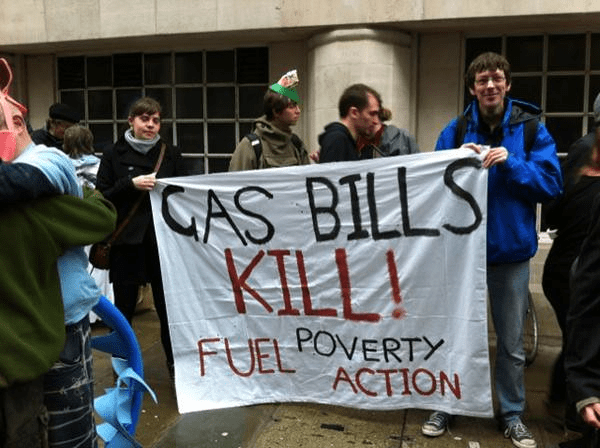
By the End Fuel Poverty Coalition
As households brace for 13.5% rise in average energy bills today, the cost of gas is now set to remain high throughout 2026 according to expert predictions.
The additional £221 added to the average annual household bill from 1st July is to cover the cost of gas which shot up as a result of the Iran conflict. That pushes the average household energy bill and pushing it to £1,862 per year.
The increase compared to current prices is driven almost entirely by gas, with gas unit rates up 28% quarter-on-quarter, a direct consequence of the disruption to global energy markets triggered by the US-Israeli conflict with Iran and effectively creating what some campaigners have called a “Trump Tax” on energy.
For households across the UK, this is the second major energy price shock of the decade. Bills are now 79% higher than before the energy crisis began in winter 2020/21, and the cumulative extra cost to each household since 2021 is estimated at £4,800.
The rise comes at a moment of wider financial distress. Recent Opinium polling for the End Fuel Poverty Coalition found that three in ten UK adults are already in energy debt or worried about falling behind. For parents with children under 18, that figure rises to 45%. Meanwhile, UK energy companies posted around £3 billion in profits from their UK operations alone in the first quarter of 2026, equivalent to £102 for every household in the country.
Forecasts
Cornwall Insight predicts that the energy price cap is forecast to remain at similar levels from 1st October 2026 with unit costs for gas 24% higher than prices before the Iran conflict and daily gas standing charges 7% higher.
From the October price cap, Ofgem will recalculate the typical household consumption values it uses to calculate the “average household energy bill”, which means a focus on unit rates and standing charges will become more important.
The End Fuel Poverty Coalition estimates that as a result of increases in energy costs, as many as 13.5 million households will now be spending more than 10% of their income after housing costs on energy. Of these 5.5 million will be spending more than 20%.
Simon Francis, coordinator of the End Fuel Poverty Coalition, said: “Households don’t experience the Ofgem price cap as a percentage on a graph, they experience it as a bill going up while energy industry price shock profiteers make billions.
“Millions of people are in energy debt or worried about falling behind, millions more will face a summer of rising bills that wipes out any chance they had to prepare for winter. And a growing number of households are spending an unsustainable share of their income just to heat their homes in winter and keep them cool in summer.
“Cornwall Insight’s forecast of a small fall in October offers little comfort, especially given that this is entirely predicated on a fragile ceasefire, with households still exposed to the volatility of fossil fuel prices.
What Andy Burnham must do
“Sadly, there was little recognition of this reality in Andy Burnham’s speech in Manchester. The Government cannot wait any longer to act, and the next Prime Minister inherits that same urgency. If it is to be Andy Burnham’s vision of a rewired Britain, then the new PM must also rewire how energy bills are set: devolving control of energy will count for nothing unless it comes with a permanent social tariff, an end to energy debt, and a credible plan to break the link between gas and electricity prices.”
Campaigners are also calling for the next Prime Minister to fast track the electrification of the UK, ending the reliance on fossil fuels which has now created two huge energy price shocks this decade.
Uplift deputy director Robert Palmer said: “Hard-up Brits are already struggling and Andy Burnham is right to put tackling high energy bills high on his agenda as we all face a hike of over £200.
“While we continue to rely on oil and gas, our bills will be affected by global events like Trump’s war with Iran, which has caused most of this current price hike.
“The good news is that UK renewable energy is now protecting us by replacing lots of volatile gas in our power system. Unlike gas, electricity prices haven’t spiked– and we’re seeing more households wanting to switch to solar power, heat pumps and electric cars as a result. The government now needs to make it so everyone can benefit from homegrown, clean electricity.
“And while our current dependence on oil and gas is making us all poorer, it is making a handful of oil and gas companies extremely rich. Oil bosses are pushing for more North Sea drilling because they want to keep profiting at our expense. New fields, like the Rosebank oil field, will not take a penny off our bills – it just means more profit for companies like Shell.
“The next Prime Minister must put the interests of billpayers before those of billionaire fossil fuel companies and get us off oil and gas.”
The UK’s structural dependence on gas means it is at risk from ongoing fossil fuel global price volatility. Long-term energy security cannot rely on a declining North Sea, where firms have already extracted around 90% of commercially viable gas while posting billions in profits. Relying so heavily on gas is a dead end as the North Sea runs out due to the basin’s ageing nature, which even industry figures acknowledge.
The Energy Debt Crisis
People are making impossible choices to cope. 32% of those in energy debt have used less energy by turning the heating off or taking shorter showers. 25% have kept their home colder or warmer than is comfortable. 21% have missed rent or mortgage payments. 21% have skipped meals. 18% have used a foodbank to help cope with energy costs.
The health toll is mounting. 22% of those in energy debt say it has affected their mental health. 19% report physical health impacts. 21% experience sleepless nights because of energy bills or arrears. 14% say energy debt has affected their children’s health and wellbeing.
Supplier support is failing those most in need. More than one in ten (13%) of those in arrears have had no contact from their supplier in the past 12 months. Only 8% have been referred to debt advice by their supplier.
Summer will bring new pressures
The vast majority of existing homes are at risk of overheating in extreme heat events with the poorest neighbourhoods seven times more likely to be vulnerable to heat stress. With bills rising, households will need to run fans and cooling equipment at exactly the moment their costs are going up.
This price rise also means that any chance households had to reduce energy debt or build financial reserves before the winter heating season is being wiped out. Current forecasts suggest the October cap could remain at a similar level, meaning millions face an extremely difficult year unless support is confirmed.
Energy firms are profiting as households struggle
UK energy industry profits reached around £3 billion in the first quarter of 2026 alone, equivalent to £102 for every household in the country. Global profits across major energy companies reached £26.2 billion in Q1 2026. The combined wealth of 16 energy-linked individuals in the Sunday Times Rich List grew by £2.8 billion in a single year to £74.2 billion.
The End Fuel Poverty Coalition and its 100+ member organisations are calling for urgent action. On 18th March, the Coalition wrote to ministers setting out the need for an emergency support framework, a new Alternative Fuel Support Scheme for off-gas households, targeted unit rate reductions from July, a national energy debt relief scheme, and reforms to Cold Weather Payments and the Warm Home Discount.
The Electricity Bills Taskforce, a coalition of consumer groups, businesses and academics, is calling on the government to do more to reduce energy bills and cancel out the impacts of the global oil and gas price spike. The taskforce has developed a range of options for reducing energy bills. Their top recommendation is to remove government levies from electricity bills. This could immediately reduce household bills by over £120 per year, and reduce business energy costs by over 20%.
The crisis is also shifting public attitudes. Survation polling found that 35% of the public (19.3 million people) have become more interested in home energy saving technology since the conflict began. Separately, 77% agreed that “history just keeps repeating itself with energy prices” and 72% felt that reliance on oil and gas leaves the UK vulnerable to global price shocks. A further 74% said it was morally wrong for energy firms to profit from the crisis, with public support for the Windfall Tax running at two to one.
A political priority
Whoever is the PM for the long-haul, they need to make bringing down bills a central commitment, not an afterthought. The Winter Fuel Payment disaster and public perception of inaction on living costs helped create the current leadership vacancy. Bold action on clean energy, home insulation and a permanent social tariff offers the next Prime Minister a direct, tangible way to show the government is working for ordinary people. Tinkering at the edges will not be enough. Households need a leader who will stand up to the price shock profiteers, legislate for a proper debt relief scheme and chart a credible course off the gas price rollercoaster for good.
The Energy Independence Bill is the opportunity MPs cannot afford to waste.
Nearly 20 million consumers say they want to make the switch to clean energy following the Iran conflict and the price shocks it triggered. But they need help to make the move – and better protections from the excesses of a broken energy system. The Bill must lock in the renewable rollout, break the link between electricity prices and volatile gas markets, and back a properly funded programme to get heat pumps and insulation into lower-income homes. Reducing electricity costs fairly and ending the price shock profiteers agenda that would keep us hooked on the fossil fuel markets must also be delivered.
Image: https://www.flickr.com/photos/cj_collective/6992454230 climatejusticecollective Licence: Attribution 2.0 Generic Deed CC BY 2.0
 Labour Hub