
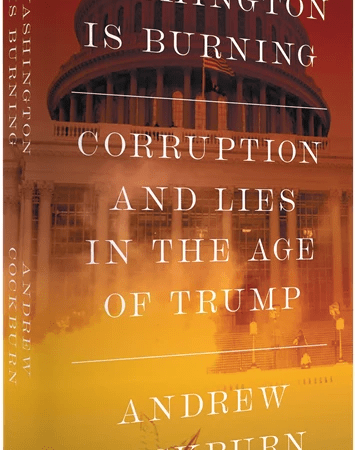
Mike Phipps reviews Washington Is Burning: Corruption and Lies in the Age of Trump, by Andrew Cockburn, published by Verso.
It is now mainstream to describe the United States as being in an era of democratic decline. The manipulation of America’s electoral process is one aspect of this trend. Executive overreach is another. Andrew Cockburn’s new book drills down into both.
Imperial presidencies
The deliberate destruction done to government agencies in the early days of Trump’s second term, the unleashing of federal immigration officials to occupy whole cities, kidnapping and deporting legal residents, the persecution of dissident media through the courts – all were designed to display naked power and inculcate fear, a preparation for further assaults on civil liberties, workers’ rights and freedom of expression.
Yet the overriding characteristic of executive overreach is that it’s not particularly new. Trump may boast about the emergency powers at his disposal, but it was that great liberal FD Roosevelt who used them to incarcerate 120,000 Americans of Japanese ethnicity during World War Two. \When President Nixon over fifty years ago commissioned burglaries of the opposition party’s headquarters and then orchestrated a cover-up, his legal defence was that “when the president does it, that means that it is not illegal.” Fortunately, the courts took a different view. But a decade later, another president, Ronald Reagan presided over a murderous covert operation in Nicaragua using money generated by illegal secret arms sales to Iran.
Both Bush Sr (Panama) and Clinton (former Yugoslavia) carried out military intervention without Congressional approval. Bush Jr used congressional authorization for military force against Al-Qaeda after 9/11 to occupy Iraq; and even Obama “broke new extra-constitutional ground in ordering the execution by drone of a US citizen.”
That Trump has autocratic ambitions is indisputable. He has been aided in his sidelining of democratic norms by his control of the appointments of America’s federal judges. Many of the most supportive senior judicial appointments were made in Trump’s first term. As a retired senior federal judge told the author, “Trump II would have been impossible without Trump I.”
However, “the steady shredding of constitutional impediments to one-man rule from the Oval Office would not have been possible without congressional cooperation,” Cockburn reminds us. In particular, Congress has acceded to the loss of its own exclusive right to declare war, not formally used since World War Two. Additionally, “The military-industrial complex has faced no obstacle in its decades-long inflation of threats to extract ever-increasing sums from lawmakers with little dissent.”
Yet, occasionally Congress refuses to support the President’s overseas military adventures, for example, in 2013 when it opposed military action against Syria – just as the House of Commons had done days earlier, following mass pressure on Labour MPs, some of whom belatedly recognised the folly, illegality and immorality of invading Iraq.
In short, if you want to rein in the president, elect a better Congress. The distorting role of the party machines and the corruption of the electoral process by corporate money, gerrymandering and elite capture makes this difficult, but surely not impossible? We may have a clearer view after the mid-term elections later this year.
National security
Cockburn is also an expert in national security. Unsurprisingly, he is highly critical of the US Defense Department, which like our own, often spends according to the priorities of the arms lobby, rather than the needs of effective defence outcomes. One chapter opens: “Watching a recent video of Ukrainian troops scrambling out of a US-supplied Bradley armored fighting vehicle just after it hit a mine, I remembered how hard the US Army bureaucrats and contractors who developed the weapon had fought to keep this vehicle a death trap for anyone riding inside.”
The reason: “pausing development for a redesign might have hurt their budget, so they delayed and cheated on tests to keep the program on track.” At the time this was written, the Pentagon’s budget was $850 billion a year.
A similar official cynicism surrounds the US policy of sanctions against Russia for its unprovoked, illegal invasion of Ukraine. Despite Administration predictions that Russia was “looking into an economic abyss” and President Biden’s claim that the ruble would soon be “rubble,” the Russian economy continued to grow as its oil carried on flowing. For all the rhetoric about supporting Ukraine, “Such blatant circumvention of the sanctions regime is studiously ignored by the sanctioneers, since it is necessary to ward off catastrophic energy price inflation in western economies.”
There ae lots of insights in Cockburn’s new book, and some interesting historical detours into US involvement in World War One, its atomic bombing of Japan in 1945 and the Cuban Missile Crisis. But many of the chapters lack immediacy, some having been previously published several years ago in Harper’s Magazine, of which the author is the editor. Yet, the quality of writing is excellent throughout and there is a lot here that will be new to UK readers. Highly recommended.
Mike Phipps’ book Don’t Stop Thinking About Tomorrow: The Labour Party after Jeremy Corbyn (OR Books, 2022) can be ordered here.

