
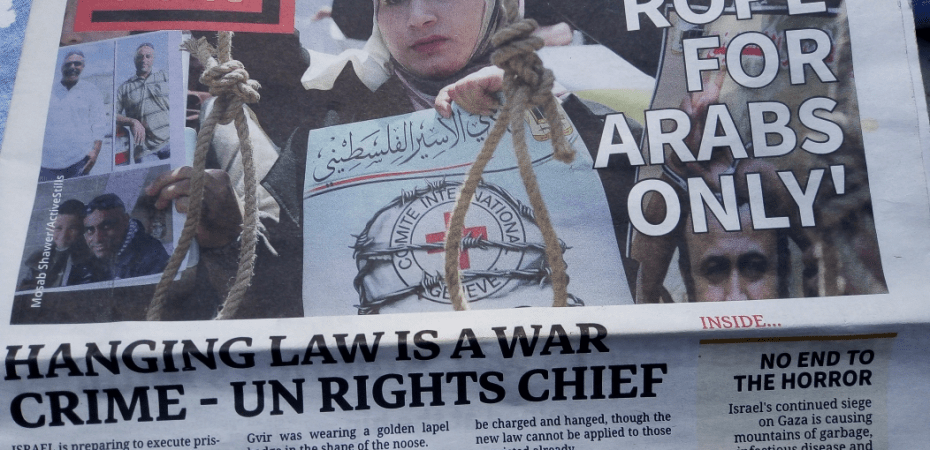
Palestine News introduces itself.
The wars in Israel are caused by bloodthirsty Arab Muslim terrorists relentlessly attacking the Jewish people and their state. That’s what Israel says of course – and apparently most news consumers of TV news in the UK believe it to be the case.
That was the notable finding of audience research by the Glasgow University Media Group for the pioneering book Bad News from Israel, which they published in 2004, and it made people think.
The problem for those of us who believe that Israel is the occupying aggressor which the Palestinian people have a right to resist with force when all else fails is not so much to prove our case – there is plenty of evidence — but to get it through to people.
The great barrier constructed by the allied forces of the security state, the political class and the corporate media to defend Israel is not about to fall down, so we have got to go underground or round the ends.
Social media offer the obvious solution. For anyone looking for honest and independent news on Palestine there is a long parade of specialist websites: Electronic Intifada, Middle East Eye, Palestine Chronicle, Middle East Monitor, Mondoweiss, plus Al-Jazeera, the Muslim Channel and Press TV, bloggers and Youtubers like Owen Jones, Jonathan Cook and George Galloway, numerous left wing and party sites and even progressive Israeli sources like Ha’aretz and +972 magazine online.
We watch them. Who else does? Well, mostly the converted, those in our own echo chamber.
For all the much-vaunted plethora of material online, the phenomena of selection and confirmation bias have been recognised for decades, caused by the range offered to consumers being constantly restricted by algorithm technology. They just don’t see what we do.
To alleviate the frustration, one small group of activists has set out to turn back the clock by more than 100 years, bypassing all electronic communications, to the age of print.
Palestine News (PN) is a quarterly tabloid-size old-fashioned newspaper launched last year by a bunch of journalists and supporters fed up with the endless Israeli cover-up. Even this nostalgic product would be useless without readers so they went even further back for their mode of distribution: by hand.
Their plan is to print thousands of the 8-page copies and hand them out to passers-by, at public events, train stations, supermarkets, parks, train stations or just in the street.
After three issues the print run is up to 21,000 and accelerating as distributors sign up. Anyone can be a distributor and while most are involved in campaigning for Palestine in one way or another, they do so individually. PN is not for instance related to the Palestine Solidarity Campaign (PSC); the PSC leadership is personally supportive, but there can be no direct connection. If there were, then PSC would control the content, and the point is to be independent.
Initially all this was done with no outside funding but donors are starting to contribute: a couple of foundations and individuals. They are starting to pay for some admin and editing work.
It has no editorial line apart from support for Palestine, and publishes little on UK angles, restricting itself to just one major item on international politics per issue (which is much argued over!): major means 600 words, nothing longer, and no opinion pieces, no bylines.
Most of the text is in fact rewritten from existing sources; it is an editing rather than a writing exercise. The style is basic journalistic English: clear and succinct but not quite tabloid; nothing fancy.
But there is strong news: PN goes out of its way to find positive stories: the third issue had a page-wide photo of 186 newly trained medical doctors in their graduation gowns who had somehow managed to qualify in the ruined hospitals of Gaza. There are a lot of pictures, nearly all from Palestinian sources – the only material that is paid for. There are always positive cultural stories, about schools, Palestinian sport (recently on football and boxing), films, artworks and even comedy.
Of course the bulk of the copy is really horrible to read. You cannot otherwise report the cynical brutality of Israeli assaults on Palestinian communities in Gaza and the West Bank; but PN does not regard the people simply as victims. It supports their struggles for dignity as well as survival.
The archaic nature of the exercise does require some counter-intuitive reasoning. As a rule left-wing agitators for whatever cause are keen, not to say desperate, to promote their offerings to anyone they can grab hold of. But the PN team can’t afford to squander their precious ink and paper on folk already well informed on Palestine. They are after the ill-informed.
The snag is that recruiting the distributors on whom the project depends requires contact with activists. This notion became real at Stop the War’s big one-day peace event in Central Hall Westminster on June 20th. Every one of the 2,000 present would have liked to read PN, but the team there with 600 copies had to select folk they could identify as likely collaborators. Happily there were plenty.
Distributors report a virtually unanimous positive reception for the paper; they find little resistance or objection. There is reason for this: it seems that many people are searching for the truth on Palestine. They see footage of children murdered by Israel on TV, then they see people marching to stop the slaughter reported as hate-filled terrorists, and Netanyahu as a statesman; and they wonder.
If the Glasgow researchers asked their questions now they would get very different answers. All opinion polls show clear though not overwhelming gut support for Palestine. But the daily message from our political class and the mass media is the opposite! It is doubtful whether this gap has ever been wider.
Little wonder that PN seems to be gaining support.
People can sign up as voluntary distributors at the website www.palnews.org.uk to receive and circulate anything between 20 and 150 copies. Yes, there is a website, though it contains only the pages of the paper and admin stuff. As we know, there is no shortage of plentifully informative websites on Palestine.
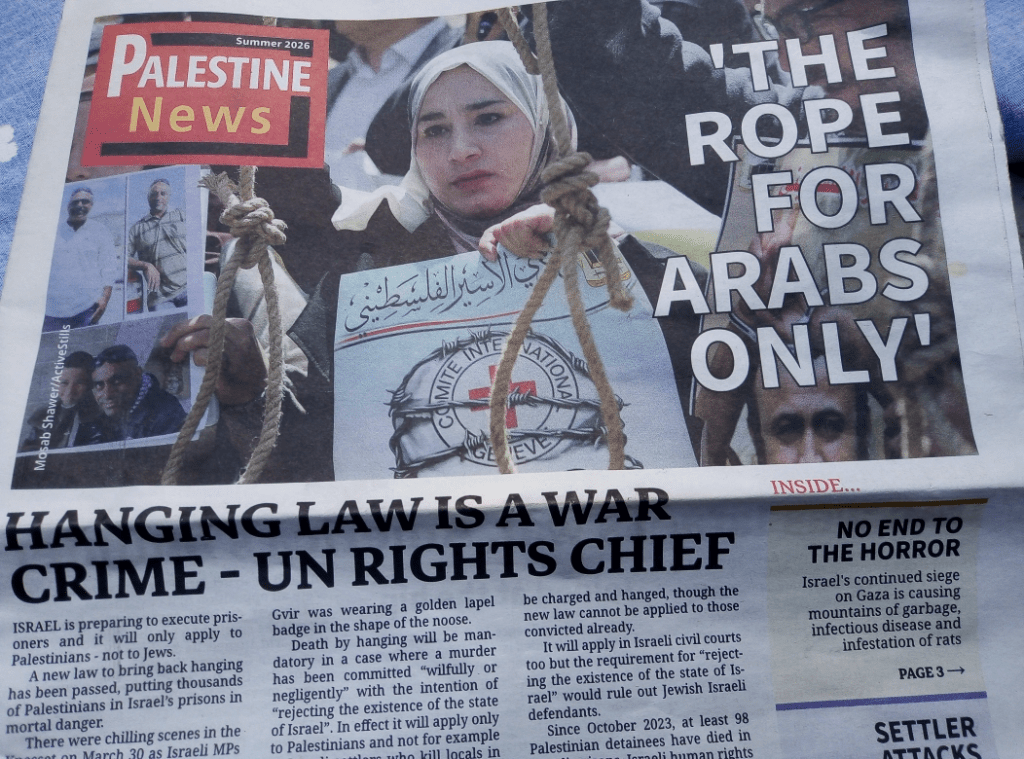
Image: c/o Labour Hub.

