
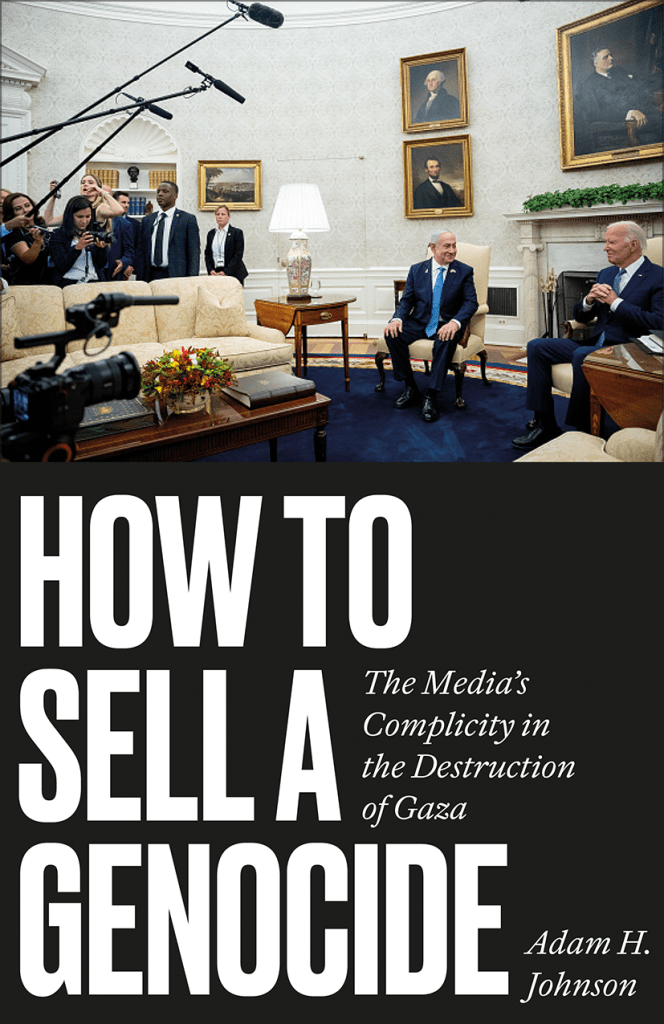
Mike Phipps reviews How to Sell a Genocide: The Media’s Complicity in the Destruction of Gaza, by Adam H. Johnson, published by Pluto.
In the Foreword to this book, the eminent Palestinian-American Professor Noura Erakat writes: “I remember vividly on October 17, 2023, seeing the BBC run a headline about weapons beneath the Al Ahli hospital. Aware of the stale and racist ‘human shields’ talking point, I immediately wondered whether the BBC was priming us for an Israeli attack. Within hours, an Israeli missile struck the hospital, killing 471 Palestinians and injuring 342 others.”
It’s not just activists who have concerns about BBC bias in relation to this conflict. In November 2024, 100 BBC staff together with 200 other media professionals penned an anonymous letter accusing the Corporation of inadequate coverage, and a failure to challenge Israeli claims, which “has systematically dehumanised Palestinians.”
In June 2025, the Centre for Media Monitoring published a damning report on the BBC’s Gaza coverage. After analysing over 35,000 pieces of BBC content, the report found that the BBC “gave Israeli deaths 33 times more coverage per fatality”; that it “applied ‘massacre’ 18 times more to Israeli casualties”; that it “used ‘murder’ 220 times for Israelis” as opposed to once for Palestinians; that “BBC presenters shut down genocide claims in over 100 documented instances”; and that, not only did the network interview significantly fewer Palestinians than Israelis, its presenters “shared the Israeli perspective 11 times more frequently than the Palestinian perspective.”
Adam Johnson’s book focuses more on the US media, and particularly on the centre-left liberal media. It aims to show that “that the genocide in Gaza was enabled, facilitated, and cheerled by establishment US media providing cover for months of a nihilistic campaign of starvation, bombing, arbitrary detention, shooting, and sexual violence.”
He starts with the unsubstantiated Israeli claim that Hamas had decapitated 40 small children it its October 7th attack. Networks dismissed Hamas’s denial of this accusation as not credible, because “we literally have video” of the atrocity. No such video ever surfaced, nor could it. The fabrication was manufactured to prepare international public opinion for what Israel was about to unleash – and the Western media facilitated the deception. One journalist who was publicly sceptical about the story faced a severe backlash from management at work and even received death threats.
One directive from CNN management in the days after October 7th even required that “all copy on all platforms that’s connected in any way to the Israeli or Palestinian stories” must “be approved in advance by the Jerusalem bureau.” This bureau is overseen by Israeli censors and is generally known for producing a more favourable slant for Israel, argues Johnson.
The cumulative effect of the wholesale adoption of an Israeli narrative by the mainstream media was to make the idea of a ceasefire unthinkable. The key was portraying Hamas as the new Isis: the main mechanism was to dehumanize Palestinians, invariably depicted as mindless terrorists whom the Israelis killed because they had no choice if they were to rescue the hostages. The double standard is evidenced by the fact that the term “massacre” was used hundred s of times by US media outlets to describe the killing of Israelis, and never for the killing of Palestinians.
When the Israelis bombed the Al Ahli hospital, mentioned above, killing hundreds of Palestinians, the majority seeking refuge in a tent camp in the hospital parking lot, the US media largely accepted Israeli propaganda that it could have been a rogue Hamas rocket. “What could have been a galvanizing moment for global opinion to marshal support to end the ongoing mass killing and eventual genocide, to tell Israel to call it quits and seek a political solution to the occupation, was inverted,” writes Johnson. Worse, news editors began demanding confirmation from the IDF itself before attributing responsibility for attacks, something without precedent in other conflicts.
And even when the IDF did admit responsibility, claiming that whatever school or hospital it bombed had been a shelter for Hamas combatants, these claims would invariably be repeated uncritically in the US media without independent verification. “Gaza City Hospitals Are Caught in Deadly Crossfire,” is one typically misleading New York Times headline.
A double standard also permeated – and still does – the media’s language. Israelis seized are “hostages”; the 3,000 Palestinian captives held without charge by Israel are “prisoners”. Israeli’s young are “children”; Palestinians are referred to as “minors”. At the same time, advocates of Palestinian rights are increasingly excluded from media debates.
Johnson contends that the US media also played a central part in helping the Biden administration distance itself from the conflict, portraying it as unable to bring it to an end, when it clearly could – as even Israeli officials admitted. Instead, the conflict was increasingly reported as a kind of ‘natural disaster’, with Israel’s agency as the perpetrator of bombardments killing multiple civilians often omitted from headlines – in stark contrast with Russia’s airstrikes on Ukraine.
The climate of intolerance spawned fear among journalists who questioned the institutional bias. The May 2024 National Writers Union report detailed over 100 different cases of retaliation against media workers in the months after October 7th because these workers expressed undue sympathy for Palestinians.
The witch-hunt soon spread to campuses. Student protests and encampments produced a fierce backlash which, by the end of 2024, saw around 3,000 detained or arrested. Thousands more faced harsh university discipline—suspension, expulsion, and loss of degree. These attacks were underpinned by hundreds of articles in the media focusing on alleged campus antisemitism: only five were dedicated to anti-Muslim racism or Islamophobia, despite a big uptick in incidents expressing this.
In a recent in-depth interview with Owen Jones about his book, the author pinpointed the goal of US media in relation to the conflict. He said it was “not to protect Israel’s image, but to remove liberals and liberalism from responsibility.” The template used for Gaza could well be applied again to future conflicts.
Johnson’s book is a meticulous and evidence-led piece of research. It would be really useful to see a similar exercise undertaken in relation to the wider UK media’s coverage of the conflict.
Mike Phipps’ book Don’t Stop Thinking About Tomorrow: The Labour Party after Jeremy Corbyn (OR Books, 2022) can be ordered here.
 Labour Hub