
By Jessica Field and Signe Gosmann
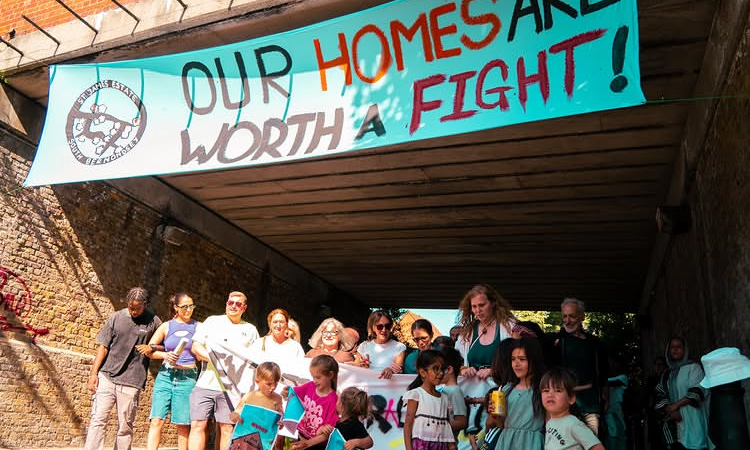
Labour Councillor Andy Bates recently wrote about the shocking mass eviction underway in the St James estate, Southwark: 180 households being pushed out of their homes through eviction notices or massive rent rises. Fifty households were issues “no fault” Section 21, just before the law changed on 1st May. Dozens overstayed; 30 have now been notified the landlord has instigated legal proceedings to evict them. Many more have faced untenable rent hikes of several hundred pounds.
The local MP Neil Coyle says he believes the landlord, corporate investment company BMR Group, wants to turn the houses into profitable Houses in Multiple Occupation (HMOs). The estate’s managing agent told the BBC there was “no proposal to convert the estate as a whole into HMOs” – but that does not rule out individual properties. Bates says that when he went door-knocking recently, he discovered two houses that appeared to be in multiple occupation. Residents explained to him they had been placed there by Lambeth Council in temporary accommodation.
In theory, some of the evicted residents could be placed back into new HMOs on the St James estate, only this time as homeless, with few rights and sharing what was once adequate space with strangers. All this would be at a higher cost to the council.
This is of course speculation, but it would not be the first time a commercial organisation makes a higher profit from homelessness than from the regular rental market. The story – more than one estate’s battle to stay in their homes – is evidence of a broken housing and homelessness system.
In our recent report into the history of temporary accommodation, Lifelines, we expose how temporary housing has often been expected to absorb housing market shocks. This can be extremely costly and compound the exclusion felt by some of the most vulnerable in society.
Four red flags are visible in what’s happening to St James residents, and they should raise alarm bells for tenants and councils everywhere.
First, the homelessness system is being presented as a safety net for the tenants, but it is not fit for purpose. Bates reports that Southwark and other councils have been discharging their statutory homelessness duties into private rentals in the St James since 2011. Faced with eviction notices, those same households are now being funnelled back to Southwark Council to develop Personal Housing Plans in a new round of homelessness.
Successive hard-won reforms – including a legal definition of homelessness in 1977, the prevention agenda in the 2000s and relief duty extensions in 2017 – have still not delivered meaningful security for many people experiencing homelessness. The system needs an overhaul.
Second, mass evictions come at substantial cost to local rate payers, and to the state. Southwark, like many boroughs across London, is facing a temporary accommodation (TA) crisis. The council was operating at a £17 million projected overspend for TA across the 2025-26 financial year. This cost “continues to be the council’s most material General Fund risk,” according to a February budget review. There is simply no capacity in Southwark, or elsewhere across London.
Many councils respond to constraints by exporting families elsewhere. Over half (51 per cent) of Southwark’s households in TA were placed out of their home area in 2024, slightly above the London-wide average of 45 per cent.
Relocation has been used to manage homelessness caseload and costs since the Victorian era, cutting families off from support networks. Yet, impacts are uneven, disproportionately affecting marginalised groups. During the 19th century, relocation fell hardest on Irish migrants; post-war, on Commonwealth arrivals; in recent decades, on households from Black, Asian and migrant backgrounds.
Third, and related, there is no clear equalities data on how the mass eviction will impact the St James community, which risks deepening systemic discrimination baked into the system. Bates writes that many households have disclosed to him mental and physical health conditions. News articles have documented families fearing disruption and dislocation from their community – including one who fears the impact of eviction on their neurodivergent child. Census data from 2021 tell us that well over a third of residents from the St James estate wider area are from Black, Asian, Mixed or Multiple ethnic backgrounds.
We already know that temporary accommodation is unfit and unsafe for children and unsuitable for people with specific health needs or disabilities. Just like we know that Black and other minoritised households are disproportionately allocated out of area placements. These discriminatory effects have been documented over decades, yet statutory data collection and equalities-based action remain inadequate.
Fourth, the St James tenants are left fighting at the grassroots as activists-by-necessity, pulling every lever they can in a fragmented system. This gruelling work – traced by one of us across British rented housing history – often falls on people with few resources in one of the most turbulent times of their lives. Fighting is exhausting and keeps tenants on the back foot, knocking the same issues at different doors.
The problem is not the tenants’ – nor is it necessarily the council officers operating in departmental silos with entirely different mandates (housing, health, welfare, education). The problem is systemic and can, in part, be traced back to a Victorian era that saw homelessness as an individual failing. Post-war welfare state expansions were welcome but continued to tackle homelessness case-by-case rather than as a general housing system failure.
Temporary accommodation is an essential safety net in a critical moment of need. It should not be used to shore up corporate greed and an inadequate public housing system. The system needs an overhaul that puts occupants and housing security first. Until then, St James residents must be supported to stay in their homes and community.
Jessica Field is author of Lifelines and Eviction: A Social History of Rent (Verso, 2025), reviewed on Labour Hub here. Signe Gosmann is Research Lead at Justlife. Lifelines: A History of Temporary Accommodation in England 1834-2011 was published by Justlife in June 2026.
Image: c/o Insta@stjamestenants


[…] Separate but concurrently, many households from the rest of the estate were issued Section 13 rent hikes – again, pre-RRA but with market comparison principles that have survived reform. St James tenants now face rises of several hundreds of pounds per month – costs they can’t afford. Local councillor Andy Bates says the landlord is converting many of the newly vacant houses into lucrative Houses in Multiple Occupation (HMOs), some of which appear to be let as temporary accommodation. […]