

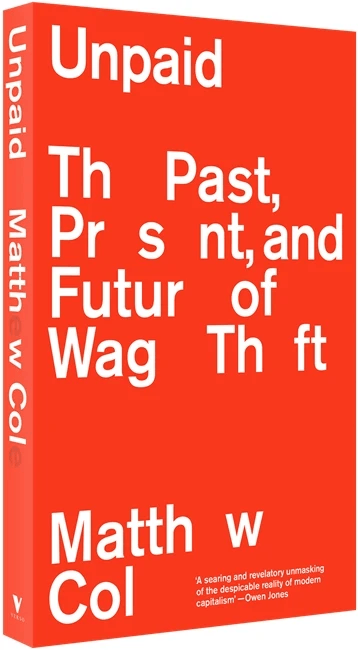
Mike Phipps reviews Unpaid: The Past, Present, and Future of Wage Theft, by Matthew Cole, published by Verso.
First some shocking numbers: in 2018, a UK government audit found that Marriot Hotels, whose UK arms made £8.2m in gross profits in 2019, underpaid 279 workers £71,722 through unlawful deductions. From 2017 to 2024, 45,781 claims were lodged for unauthorised deductions, plus 29,886 additional claims, mostly around unpaid holiday. Yet out of more than 4,800 firms fined by the government since 2016, only 109 have actually paid – just £95,000 out of £9.8m in fines.
Matthew Cole estimates five million workers in the UK put in a total of two billion unpaid hours – £35 billion of free labour – annually. A UK employer can expect an HMRC inspection once every 250 years. Britain ranks 27th out of 33 countries in terms of labour protections.
The situation is worse in the US, where a federal review found that 84% of restaurants had committed wage and hour violations. Wage theft across the economy could be as high as $50 bn a year, and that doesn’t include the billions of dollars of prison work done for private companies. ‘Communist’ China also has a big wage theft problem, documented here.
Union members are three times more likely to pursue a case to recover lost wages. But with unions in decline, and penalties for companies so low, wage theft is effectively incentivized as a cost of doing business.
In the US, many of the companies routinely brought to court for shaving hours off workers’ time cards or forcing employees to work off the clock are big household names – McDonalds, Apple, Walmart. Young workers, women, people of colour and migrants are more likely to experience minimum wage violations, as they comprise a greater share of low-wage jobs.
In the UK, almost one-third of workers with minimum wage contracts are actually paid below this threshold. One study suggested employers play a ‘numbers game’ to underpay without attracting regulatory scrutiny. Even when caught, many just ignore the judgment, sometimes closing their company rather than paying, only to start another.
It’s getting worse
The growth of the platform economy makes things worse, due to the use of self-employment contracts and piecework, which deny workers the right to collective bargaining, sick pay, or any guaranteed income at all. This leads to greater insecurity, exploitation and wage theft. A 2023 study found that only two out of thirteen US platforms could ensure their workers earned at or above the minimum wage after costs.
Most platforms use an algorithmic pay system – essentially a way to calculate the lowest rate that workers will accept, and the highest rate consumers will accept. UK platform workers face nearly identical working conditions.
Cloud platforms are even more exploitative. A worker can spend hours watching a feed, refreshing windows, looking for ‘tasks’ that pay as little as between $0.01 to $0.05 per ‘task’. It doesn’t help that the best-paying tasks are almost always ‘geo-locked’, reserved for workers in the US. Thus, “national borders and inequalities are coded into virtual space.” The International Labour Organisation estimates that for every hour of paid cloud work, workers spend an unpaid twenty minutes searching and preparing for jobs.
These workers, explains Cole, are feeding their labour into machines automating our future. They are contributing not only tangible, concrete labour but also intangible data about that labour. It constitutes a new type of transformation – surplus-labour becoming intellectual property, an intangible asset. The resultant data pipeline could serve AI in a range of products, including militarized AI systems such as Palantir’s autonomous weapons systems. By 2020, the European Data Economy was worth over €400 billion, with a growth rate of 7.6 per cent.
Abolishing wage theft, says Cole, is the definition of industrial justice. This means not just enforcing existing laws. “Stronger laws don’t write themselves” – so more favourable conditions need to be created to wage the fight for economic democracy. The author points to some significant victories but the long-term decline of unions means these are seldom enduring. The main ray of optimism in all this is that the big tech companies are developing such an unpleasant reputation that the case against them is growing increasingly popular.
Mike Phipps’ book Don’t Stop Thinking About Tomorrow: The Labour Party after Jeremy Corbyn (OR Books, 2022) can be ordered here.

