
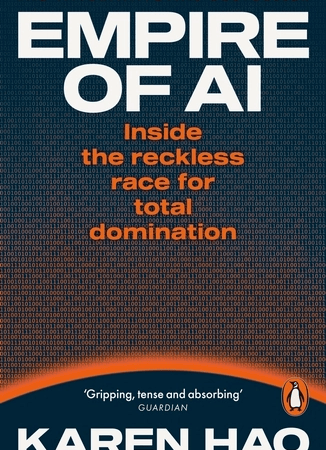
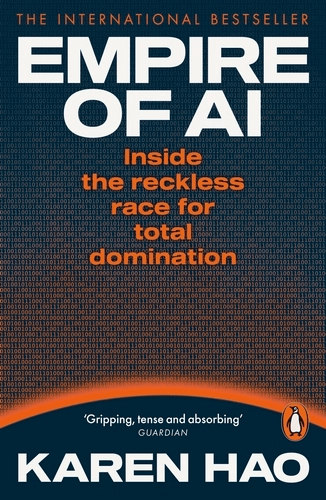
Frank Hansen reviews Empire of AI – Inside the reckless race for total domination, by Karen Hao, published by Penguin Allen Lane.
Confused by all the hype about whether AI will destroy humanity or save us from catastrophe? As I read Karen Hao’s brilliant book, the brain fog began to lift!
No one can deny that AI can be highly beneficial. For example, London neurosurgeons recently performed the first successful AI assisted operation to remove a brain tumour. They used an AI model developed in partnership with London University (UCL). The doctors and UCL were firmly in control. This underlines the fact that who actually owns and controls AI – and whether it is accountable and regulated in the interest of society – is the key to developing this new technology to benefit humanity.
However, is this the case when it comes to the massive wave of new AI investment emanating from Silicon Valley? Tech journalist Karen Hao’s meticulously researched book delivers a clear and damning account of the way that the Tech Titans are developing AI, mainly in their own commercial interests, while posing as beacon of progress and the saviours of humanity.
Hao’s book focuses in detail on the rise of Sam Altman and OpenAI and tells a complex and fascinating story, (including a failed boardroom coup to ‘save the company’ by overthrowing him in 2023). It also looks at the various oligarchs, such as Musk and Gates, involved in the race, as well as the different, (often weird), techno/ideological factions vying for influence within the companies. Above all, it exposes the clever lies and dissimulation we are being fed by Altman and Co and lists the very real damage his vision of Artificial General Intelligence (AGI) is inflicting on humanity and the environment, not only tomorrow, but in the real world today.
She points out that there are many different pathways for developing AI and that alternative, democratic models are entirely possible, but only one has been chosen and promoted by OpenAI and the Tech Titans. It’s centred on “Generative AI” (GenAI) and is deemed to be far the most profitable.
GenAI creates original content such as text, images, videos, audio/music, and even software code in response to user prompts. Unlike traditional AI, which focuses on analysing data or making predictions, GenAI produces new, unique outputs by learning patterns from vast datasets, which can then be monetised. Huge resources are being channelled into these models in the race to capture the market. They are also known as “Frontier Models” referring to the most advanced, high-capability, AI systems that exist at the cutting edge of technology. Because these are so powerful, regulatory debate often focuses on the potential “dual-use” risks—meaning a model could accidentally or maliciously be used to automate cyberattacks on critical infrastructure or assist in the design of chemical or biological weapons.
The problem with GenAI isn’t the technology itself, but who is in control, the uses to which it is put and whether there is adequate regulation, especially safety controls, on its development and deployment. After all, social media was originally marketed as a benign ‘free product’ where friends could meet and people could discuss issues, but in the hands of oligarchs we are now witnessing the extreme disbenefits of these profit-driven, unregulated business models and just how difficult it is to control them. Of course, it’s the very same Silicon Valley companies that are in control of AI development.
Hao traces OpenAI’s evolution from a safety-oriented, non-profit organisation (run by Altman and originally funded by Musk), into a huge profit-driven enterprise, with Microsoft now as its main partner. It’s fascinating to look at how and why this transition took place. She examines the human, environmental and political costs hidden beneath the industry’s sleek marketing and warns about the concentration of corporate power shaping our future. Her central theme is that leading AI companies are not benevolent pioneers but act as ‘Empires’, pursuing a modern form of neo-colonialism. Under the guise of building AI for the greater good, they extract resources at low cost – minerals, water, power, information and labour – and exploit the global south in particular.
ChatGTP and other models do not naturally understand human speech or distinguish between safe and harmful content. They must receive “human feedback” to be trained using vast datasets. To address this the firms exploit a marginalized workforce in countries such as Kenya, the Philippines and Venezuela, paying them a pittance to ‘clean up’ this data, some of it very toxic in content, ‘scraped’ from online sources to feed into AI models. Hao describes this as “digital sweatshop labour”. Workers must constantly filter out hate speech and appalling sexual and racist abuse material without any real support – their low pay, financial insecurity and psychological trauma helps subsidise the intellectual productivity of the wealthy.
GenAI development is based on Altman’s relentless “Gospel of Scale”—the belief that building AI requires exponential increases in data and computing power that go way beyond what the industry has ever done before. Billions upon billions of dollars are being invested in these projects with the building of hundreds of large and “hyperscale” data centres – enormous industrial facilities housing thousands of computers needed for training large models and powering global cloud networks. These are being built across the globe and in the US and the UK. They have huge energy needs requiring anywhere from 50 MW to over 100 MW of power on a single site to drive computers 24 hours a day. In fact, they can use more power and emit more carbon than many large UK towns – the largest ‘campus’ data centres contain up to a million computers. They also consume vast amounts of water to cool the systems and can cause noise pollution all day long.
The water footprint can easily rival the domestic water consumption of entire local communities and there have been cases of disruption to domestic supply in the US, Chile and elsewhere. This can be ‘mitigated’ by using electric cooling systems, which only increases the energy usage (two electric cooling centres have recently been approved in Southall, Ealing). The companies claim that AI will solve climate change, but the reality is they are exacerbating it by raising the demand for fossil fuels to power the sudden expansion of these centres. Hao points out that the AI companies are keen to export some of these hazards to regions with weaker regulatory regimes (as in Chile), depleting local water tables and straining electrical grids, to more quickly fuel the race for AI.
The rapid spread of data centres in the US has led to growing public opposition across the political spectrum, driven by alarm about the economic and environmental impact. There are concerns that increased demand for and power and water will drive up domestic utility bills. New York is the first state to enact a temporary ban and twelve others have considered moratoria. In a May poll, 70% of Americans said they were opposed to AI data centres in their area, with 48% strongly opposed.
In the UK awareness of the issue is growing fast as data centre plans unfold. Currently there are many data centres in the country, but fewer than forty fully operational UK hyperscale facilities, almost exclusively related to US tech giants. Some 80% of these are in London and the Southeast, mainly along the Thames Valley/Slough/West London corridor and industrial hubs like Park Royal and Docklands.
There has been fierce community opposition to the data centre included in the controversial development of the Truman Brewery site in Brick Lane East London. Although it is a medium sized facility, its power consumption will be the equivalent of 15,000 homes. The application was rejected by Tower Hamlets Council, and in partnership with the Save Brick Lane coalition, they put forward a new plan based on 350 affordable homes and community facilities. Following a public enquiry, Housing Secretary Angela Rayner overrode the council’s decision last month and approved the original plan, which is mainly the data centre, offices and only 44 homes – eleven affordable. This doesn’t bode well for the Burnham Government’s policy on AI, let alone its approach to local democracy – the data centre will service the finance sector and is supported by the unelected City of London Corporation, not by the people who actually live in the local postcode.
Further massive growth is planned across the county. Of the 100 proposed facilities in the pipeline, the majority are hyperscale builds. Since they draw so much power, developers are being required to locate some of these ultra-large ‘campuses’ further away from London. In terms of jobs directly created by the centres, most are in the construction phase. Operators like Google and Microsoft intentionally design the facilities to minimise human intervention and a single centre has around thirty to fifty full-time staff.
Only the Green Party is raising any real objections to this expansion. In contrast, the Government has been actively promoting the developments, as in Brick Lane, as part of its ‘AI growth strategy’. As plans emerge, public opposition, particularly in Scotland, is growing. At Auchertool, a village near Edinburgh, a proposal to build a centre, billed as the second biggest in the world – 35 metres high with an area larger than 100 football pitches – has been met with serious opposition. Similar objections to such centres are happening In Airdrie and Larbert. In England it is estimated that carbon emissions from just two planned centres – in Buckinghamshire and Bedfordshire – will exceed all of ExxonMobil’s UK’s emissions and pose a threat to climate goals.
The Trump administration wants the US to become the world leader in AI but has also promised to bring down electricity bills. The backlash against data centres has caused Trump to promise a “Ratepayer Protection Pledge”, a voluntary agreement he claims will keep families from footing the bill for the AI boom by passing it on to the companies. The problem, critics say, is it is ‘just words’ and not legally binding. Similar issues are likely to arise in the UK as the strategy unfolds. It’s yet another problem for Andy Burnham to resolve with a Government committed (perhaps) to tackling climate change and the cost-of-living crisis, while still following, at least in Brick Lane, the same AI policy as Starmer.
As for the data being used to train the models, it is being taken from online sources and put to commercial use, cutting costs and replacing existing jobs. This is blatantly obvious when it comes to the creative industries. The companies scrape internet data without even obtaining permission, let alone providing notice, or offering compensation to creators. Writers, artists and other internet users have had their life’s work extracted to train algorithms designed to automate their own professions. In other fields they pay qualified people to provide feedback to make sure models more marketable. Of course, on a fundamental level, much of the data they mine has already been stolen by Big Tech without our consent, in the form of behavioural information from social media, etc, which is how these “surveillance capitalist” companies began to make real money in the first place.
The intense competition and massive resource allocation surrounding the GenAI models has closed other avenues for developing AI. In the race to be the first to market, the companies have systematically sidelined more benign alternatives and recruited many of the top researchers and programmers from Silicon Valley and academia. The massive financial leverage of Big Tech has eroded the objective, academic study of AI. Historically, research was collaborative and transparent – a scientific field driven by universities. Today, the immense cost of computing power mean that only a handful of corporations can conduct cutting-edge AI research. Knowledge is being stored behind a wall of commercial confidentiality and objective peer review is being replaced by corporate PR. Hao compares this to the way that climate change ‘science’ has been funded and evaluated by oil companies, as a means of confusing debate and obscuring public accountability.
And why do leading companies like OpenAI and Anthropic (a spin off from OpenAI) keep warning us about the potential lethal danger posed by their AI models ‘escaping’, while also claiming they will solve all our problems? Altman and others have worked tirelessly and systematically to shape the global political debate and influence political systems both financially and ideologically (as in Trump’s election campaign and their promotion of Vance, a tech insider, as Vice President). Their main goal is to dilute government oversight and protect market dominance by defining safety on their own terms and to ensure ‘red tape’ does not hinder commercial deployment.
Hao argues that Tech executives continuously raise alarms about frontier models escaping or posing existential risks as part of a calculated strategy of corporate misdirection. The rhetoric helps mask present-day harms, underwrites the inevitability of AI, and aims to establish a regulatory regime which is acceptable to them.
In the US, Big Tech has convinced policymakers that ‘over-regulating’ American AI firms would hand a geopolitical victory to China. This has shifted public regulation away from broader safety laws towards a pro-innovation approach on the grounds of national security. China and its tech companies are the only real competitors that Silicon Valley faces in the race to market. Chinese firms have already produced OpenAI-type frontier models, matching US models in core capabilities, but at significantly lower cost. Arguably this may have implications for national security, but it is certainly a commercial threat to Silicon Valley. A regulatory regime focusing on Chinese competition, rather than broad public safety, also fits in nicely with Trump’s America First trade policy.
Tech lobbying has also shifted UK policy towards a ‘pro-innovation’, transactional framework by emphasising the danger of ‘falling behind’ and the opportunity of ‘joining now’. Starmer and Reeves slavishly followed Trump’s policy on AI, with encouragement from the then ambassador Mandelson, hoping to position the UK as a main European AI Hub for US tech, which would promote ‘economic growth’. Hence the massive infrastructure investments now taking place.
As for the risk of AI ‘escaping’ and doing damage, this seems to be happening now, if not quite on the existential level predicted by Altman. Incidents of AIs ignoring users’ instructions to pursue harmful goals have reached a new high, according to the “Loss of Control Observatory,” which monitors reports made by users on the social media platform X. At the same time, OpenAI and Anthropic have recently publicised episodes of serious rogue behaviour during the testing of new Frontier models where they ‘escaped’ and engaged in hacking campaigns.
The contradiction here is that the companies have already released the models doing some damage, as reported on X, yet are not even monitoring or discussing this. This is part of a policy to go to market at an early stage, without the fullest safety checks, to encourage the public and business to experiment with the technology and test and refine the models in the real world. Pre-release vetting is purely voluntary. OpenAI successfully advocated for such a framework – under the White House’s executive directives, firms voluntarily submit advanced models to the government just before public release. Clearly there needs to be strict, independent, international regulation concerning public safety before the models are released and how they are subsequently monitored to ensure compliance. But will this happen?
In fact, Altman has used safety concerns to promote an international framework for AI. Drawing parallels to the governance of atomic energy, he has aggressively lobbied the G7 to establish a US-led international forum to set global AI standards (bypassing the UN). No doubt US Big Tech would have a major role in setting such standards.
The UK lacks any effective AI regulation. In fact, it could be argued that here AI decision-making has been ‘captured’ by Big Tech, as in the US. Labour’s early promise of dedicated AI Safety legislation was dropped following lobbying claiming that ‘over-regulation’ would stall economic growth. An amendment in the House of Lords to the 2025 Data Act requiring AI firms to fully disclose the copyright data they scraped to train their models was defeated by the Government in the Commons after similar lobbying.
In contrast, the EU has agreed a two-pronged strategy of strong regulatory enforcement combined with a sovereign industrial policy. The EU aims to act as the world’s “master digital regulator” while simultaneously building its own AI infrastructure to resist Silicon Valley and Chinese tech dominance. It is currently implementing an AI Act which claims to be the world’s first comprehensive, legally binding, risk-based law for artificial intelligence.
Despite the grim realities outlined in her book, Hao ends with a call to arms by emphasizing that society must reject Silicon Valley’s myth that massive, all-encompassing Artificial General Intelligence is a necessary and inevitable step for human progress. Rather than relying on Big Tech to self-regulate, she outlines a programme to decentralise the industry and end the monopoly of the Tech Empires, across three axes of power: knowledge, resources, and influence.
Democratising Knowledge: Break Big Tech’s monopoly over scientific information. Fund independent public research labs to inspect safety and force companies to disclose training data and technical specifications.
Resources introduce regulatory blocks on data centre resource consumption. Support local communities and grassroots activists campaigning against data centres. Support the growth of data annotator unions in the Global South and force Big Tech to use minimum employment standards. Follow the “Hollywood Blueprint”, where union strikes by writers and actors forced corporate tech to adopt AI protection guardrails.
Community-Led Initiatives: Hao points to how communities can build small-scale, ethically sourced technology that serves collective needs rather than corporate profit.
Meanwhile in the UK (and having read this book), I think it’s time we began to consider how we can halt this Labour Govt’s (almost reckless?) rush to implement the AI agenda of Altman and Trump. There needs to be a full discussion of the alternative policies to be put in its place, beginning with the revival of the comprehensive AI Act promised when Labour first came into office and a full evaluation of the EU’s approach. Trade unions need to take further steps in addressing how they can represent the millions of workers in the UK who are already exploited by Big Tech in a gig economy driven by digital platforms.
Frank Hansen is a former Councillor in the London Borough of Brent.


[…] of these harms are outlined in Karen Hao’s book Empire of AI (previously reviewed on Labour Hub). They concern safety as well as other serious risks – environmental damage […]