
By Dragica Felja, Jelisaveta Djordjevic-Ristanovic and Jelena Pavic
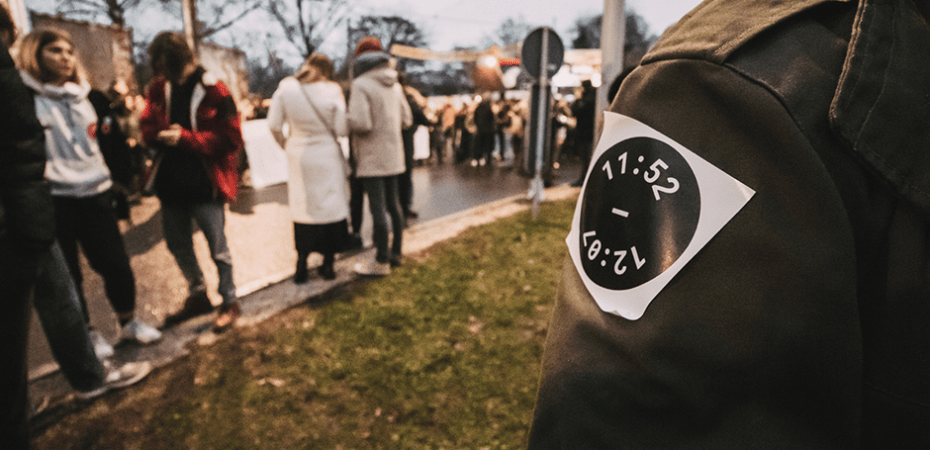
For the last 22 months, the sixteen‑minute vigil has been the constant rhythm of Serbia’s protest movement. Day after day, at 11:52 – the exact time the concrete canopy at the newly refurbished railway station in Novi Sad collapsed and killed 16 people, people step onto the crossroads across Serbia, and stand in silence for sixteen minutes. The body learns the length of the silence. Sixteen minutes becomes a measure of loss that can be felt in the shoulders and the breath. Repeated daily, it becomes a metronome of protest. And yet, after 22 months, there is still no trial, no one has been detained, and the indictments being prepared avoid the central issue: accountability at the highest levels of government.
But the country around that silence has shifted dramatically. On 9th September, the president announced parliamentary elections. Civil society organisations that monitor elections in Serbia have long warned of widespread irregularities, and activists have repeatedly raised concerns about the high risk of violence. The stillness at 11:52 continues, but it now unfolds against a landscape of escalating political tension.
In that atmosphere, the vigil’s quiet ritual reveals its deeper layers. Standing in public is a claim on space: it interrupts the ordinary circulation of the city and forces a moment of recognition. It is a small act of occupation, not dramatic, not loud, but insistent. For sixteen minutes, people hold a piece of the city that is usually given over to cars, noise, and movement. They turn a stretch of road into a place where attention has to slow down.
That claim on space also creates a moment of choice for everyone who encounters it. The vigils ask something of bystanders: will you stop, or will you pass? Will you look, or will you look away? On some days, only a handful of people step onto the crossroads and as they do, slowly others join them. Drivers pull over, shopkeepers step outside, strangers join for a few minutes and then leave.
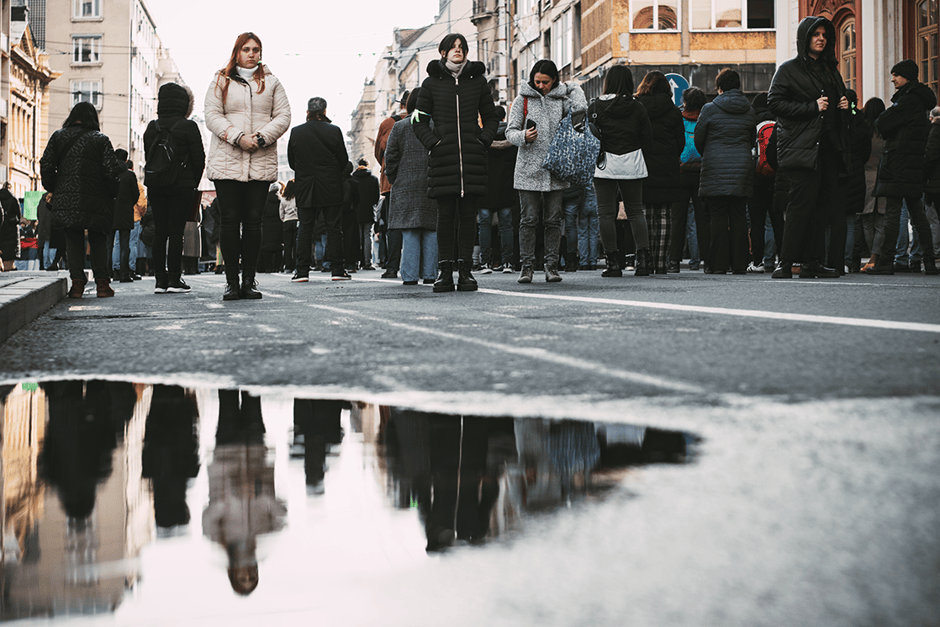
That habit has not gone unchallenged. The vigil almost always provokes anger in some bystanders. People shout, swear, and sometimes threaten those standing in silence. The vigils have also been met with hostility from the highest levels of government. In August 2026, President Vučić publicly described the sixteen‑minute silence as a “satanic act,” a remark that sought to frame a peaceful ritual of mourning and accountability as something dangerous or illegitimate.
Cars have been driven into participants on multiple occasions. At the largest mass vigil on 15th March 2025, where more than 300,000 people stood in silence, according to BBC reporting witnesses interpreted the sudden panic and stampede as the effect of a sonic device. The Serbian court has since ruled that a banned sonic weapon, known as a Long Range Acoustic Device (LRAD) was not used, and has cautioned that repeating the allegation may carry legal consequences.
But the vigils have proved resilient. People returned. The silence, in that sense, is both shield and target, a fragile public good that must be defended. Aleksandra Jovanovic, one of the regular participants in daily vigils in Belgrade said: “We have marked 22 months since the collapse of the canopy. There is still no justice for the 16 people who were killed, including two children. There is no will from those in power, and the institutions are not doing their job. We, the citizens, are visible every day at the crossroads by the Faculty of Law, standing with the students, almost 700 days now. In snow, in rain, in sun, in wind. You wouldn’t believe it, but almost none of the people who come to the 16‑minute blockade have taken a holiday. Not last summer, and not now. Determined to see justice, we will keep standing and reminding people of the terrible tragedy that many have already forgotten.”
Aleksandra’s words capture the endurance of the vigil, but they also sit within a political moment that is accelerating. In the days after the election was announced, the student movement took a decisive step: they published the names of the candidates who would stand in the elections under the banner ‘The Student List – Students are Winning’ (Studentska Lista- Studenti Pobedjuju). By doing so, they confirmed that they intend to take part in the elections as an independent civic group rather than through any political party.
More than 80,000 people signed their support for them within days, an extraordinary show of trust in a country where public confidence in institutions has been steadily eroded. The response was not confined to one demographic: parents, teachers, pensioners, and workers all signalled that they see the students as credible custodians of a different political future.
One participant described the experience: “I waited in line for 10.5 hours to certify my signature, even though I knew the Student List had already collected enough signatures the day before in Belgrade. Everyone around me knew it too. We waited because it felt like the most important act of support we could give to our youth and to our future. The queue in Novi Sad was around 800 metres long for the entire 11 hours, with at least a thousand people present at any moment. Being there with fellow citizens of all ages, feeling that energy, listening to people who simply want normal functioning of our own country is something I will treasure. It felt like a day when we all made a difference.”
The students’ programme is intentionally spare. It focuses on restoring institutional accountability, ending political violence, protecting independent media, and securing fair electoral conditions. It is not a grand ideological platform but a demand for basic democratic repair, a return to the minimum conditions under which political life can function without fear.
Domestic and international election‑monitoring organisations have echoed the urgency of these demands. Reports over multiple election cycles have documented persistent irregularities in Serbia’s electoral processes. An independent, civil society organisation dedicated to strengthening democratic culture and civic activism, CRTA, reported that from March to early September 2026, Serbia entered a pre‑election period marked by growing polarisation, threats of violence, and an increasingly blurred boundary between the state and the ruling party.
Their report notes that the ruling majority kept society in prolonged uncertainty about election timing, while conditions for fair competition deteriorated across legal, institutional, financial, and media spheres. In just four months before the elections were announced, CRTA’s observers documented more than 1,200 instances of on‑the‑ground activities by senior state officials (effectively functioning as unofficial pre‑election campaigning) and almost one‑fifth of these cases showed elements of misuse of public resources.
In addition, 85 politically motivated physical and verbal incidents were recorded, and most alarmingly – misuse of security services, including the use of Pegasus spyware on the phones of 14 student and opposition party activists. Media inequality intensified, with the main state TV channel, RTS, allocating 96% of political airtime to the ruling majority. Media regulatory bodies remained inactive, and media concentration increased in favour of actors close to the government. The report concludes that the campaign effectively began long before elections were officially announced.
These concerns sit alongside a growing fear that the threat of violence during and after the elections is extremely high. The Kofi Annan Foundation’s the Electoral Vulnerability Index shows that Serbia stands apart from the rest of the EU candidate countries, with a high risk score of 48.8 and an estimated 89.6% probability of electoral violence. The report highlights long‑standing problems: repeated contentious elections, government intimidation, media imbalance, pressure on public sector employees, vote‑buying, and widespread distrust in institutions.

The sixteen‑minute vigil does not stand alone in Serbia’s political landscape. It can also be compared to other silent protests around the world, where quiet presence becomes a form of public truth‑telling. But its meaning is unmistakably shaped by Serbia’s present context. For decades, people there have used silence to mark loss, resist violence, and insist on accountability when institutions fall short. The daily stillness at 11:52 carries that tradition forward in its own way. It is different in form, but similar in spirit: a collective refusal to let violence be normalised, a moral stance taken in public, and a reminder that even in a fractured political moment, people can hold space for truth without speaking a word.
Dragica Felja, Jelisaveta Djordjevic-Ristanovic and Jelena Pavic are three Serbian nationals who were active in the student protest movement of the 1990s. One now lives in the diaspora, while two remain in Serbia. Drawing on their lived experience and long-standing civic engagement, they reflect on the legacy of protest and the resurgence of grassroots resistance. They wrote a shorter piece about Serbian protest, published in The Big Issue, in February 2025 and an article published on Labour Hub in January 2026.
All images included were taken during protests in Serbia and are used with permission from the Instagram profile avtomatavtomata.
 Labour Hub