
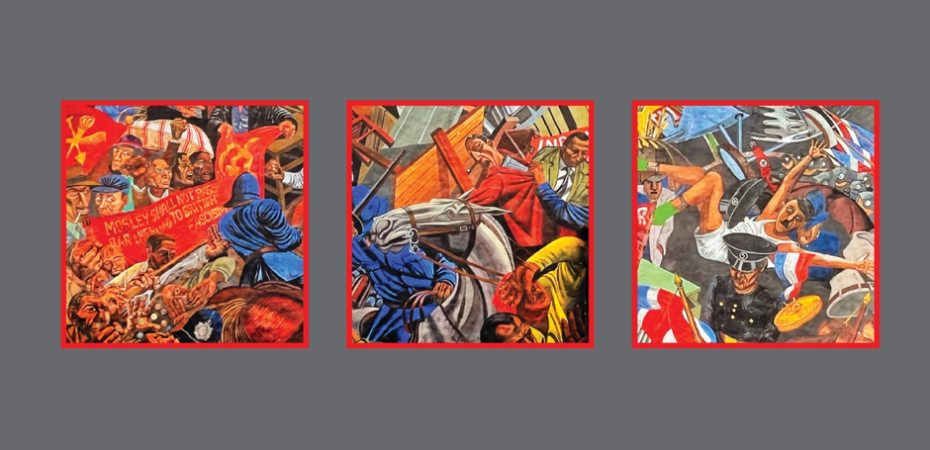
Mark Perryman recalls the role of Phil Piratin in stopping Mosley and the British Union of Fascists.
Phil Piratin was a Communist Party activist and organiser in Stepney, East London, who played a key role in the Cable Street people’s blockade which successfully stopped Sir Oswald Mosley leading his British Union of Fascists (BUF) marching through the East End ninety years ago, 4th October 1936.
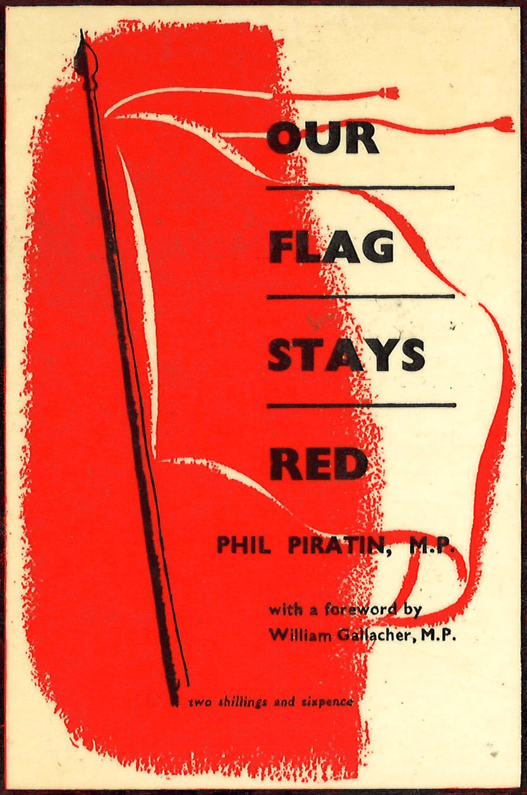
In his autobiographical account Our Flag Stays Red, first published in 1948, Piratin details the community campaigning that not only built the blockade but was to break the support for the BUF in East London which by the march numbered 4,000 paid-up members and countless thousands more supporters.
Controversially, Piratin argued that instead of demonising these proto-fascists, a deep-rooted community activism was required to both understand this support for Moseley, and detach it from him and his fascism. Attending undercover a Blackshirts march, he observed:
“I knew some of the people, some of the men wore trade union badges. This had a terrific effect on my attitude to the problem. While we would fight Mosley’s thugs where did you get by fighting the people? We should ask ourselves: ‘Why are these ordinary working-class folk (it was too easy to call them lumpen) supporting Mosley?’ Obviously because Moseley’s appeal, struck a chord. There were certain latent antisemitic prejudices, it is true, but above all these people, like most in East London, were living miserable, squalid lives. Their homes were slums, many were unemployed. Those in work were often in low-paid jobs. Therefore we should help these people to improve their conditions of life, in the course of which we could show them who was really responsible for their conditions, and get them organised to fight their real exploiters.”
It was a view initially rejected by the Communist Party, perhaps not unsurprisingly with the immediate campaigning focus on building the support to stop Mosley marching. It was a campaign Piratin not only supported but played a leading role in. Unlike those whom he and his fellow campaigners might have expected to join in: “The Labour Party, the Daily Herald the News Chronicle, the Board of Deputies all appealed to the people to stay away.”
Thankfully thousands of Labour Party members, trade unionists and the Jewish community ignored this ‘advice’ and on 4th October helped make history. Piratin’s eyewitness account provides the detail: “On the morning of 4th October there was a feeling of impending battle. Loudspeaker vans, organised by the Communist Party and the Jewish ex-Servicemen’s movement, were touring the intended route of Mosley’s march. The Young Communist League, led by Harry Gross (later killed in Spain) marched round the streets with slogan-banners. The mood of the police was already to be seen even early in the day. The Jewish ex-Servicemen’s Association, composed solely of members of the British Legion, had organised a morning march around Stepney to advertise the counter-demonstration. They wore their medals and decorations. Led by the British Legion standard, they conducted their march in excellent discipline, and were very well received. At about half-past eleven they were about to pass westwards along the Whitechapel Road crossing New Road. The police had put a cordon across this and refused to let them march… It was evident that the police intention was to interfere with this peaceful demonstration by ex-Servicemen. A fight took place with the police for the rights of ex-Servicemen to march in their own borough. Mounted police attacked. The British Legion standard was fought for; eventually the police captured it, and in front of the eyes of these ex-Servicemen tore the British Legion Union Jack to shreds and smashed the pole to pieces. The police had begun to ‘maintain law and order.’
“From an early hour people began to gather at Aldgate with the police shoving them around. Then the police really moved in. Six thousand foot police and the whole of the mounted division were on duty, posted between Tower Hill and Whitechapel. Sir Philip Game, the Commissioner of Police, had his headquarters in a side street off Tower Hill. Police wireless vans moved around, reporting frequently. A police ‘observation’ aeroplane flew low overhead. Every chief police officer in the Metropolis was on duty. Special constables had been drafted in to take the place of the ‘regulars’ withdrawn from other parts of London.
“After the police came the fascists. They came in coaches from all parts of London and the country. Here and there were scuffles, coach windows were smashed and some early casualties taken away. The fascists were due to march at 2 pm. The police, aiming to keep Leman Street clear, tried to force a path through the crowd, estimated to be at least 50,000, that blocked the whole of Gardner’s Corner. At the junction of Commercial Road and Leman Street a tram had been left standing by its anti-fascist driver. Before very long this was joined by others. Powerless before such an effective road-block, the police turned their attentions elsewhere. Time and again they charged the crowd; the windows of neighbouring shops went in as people were pushed through them. But the police could make no impression on this immense human barricade.
“It was obvious that the fascists and the police would now turn their attention to Cable Street. We were ready. The moment this turn became apparent the signal was given to put up the barricades. We had prepared three spots. The first was near a yard where there all kinds of timber and other oddments, and also an old lorry. An arrangement had been made with the owner that this old lorry could be used as a barricade. Instructions had been given about this, but when someone shouted ‘Get the lorry!’ evidently not explaining that it was in the nearby yard, some of the lads, looking up the street, saw a stationary lorry about 200 yards away. They went along, brought it back, and pushed it over on its side before anyone discovered that it was not the lorry meant to be used. Still, it was a lorry, and supplemented by bits of old furniture, mattresses, and every kind of thing you would expect to find in box-rooms, it was a barricade which the police did not find easy to penetrate. As they charged they were met with milk bottles, stones and marbles. Some of the housewives began to drop milk bottles from the roof tops. A number of police surrendered. This had never happened before, so the lads didn’t know what to do, but they took away their batons, and one took a helmet for his son as a souvenir.
“Cable Street was a great scene. I have referred to ‘the lads’. Never was there such a unity of all sections of the working class as was seen on the barricades at Cable Street. People whose lives were poles apart, though living within a few hundred yards of each other, bearded Orthodox Jews and rough-and-ready Irish Catholic dockers – these were the workers that the fascists were trying to stir up against each other. The struggle, led by the Communist Party, against the fascists had brought them together against their common enemies, and their lackeys.
“Meanwhile, charges and counter-charges were taking place along the ‘front’ from Tower Hill to Gardner’s Corner. Many arrests were made, many were injured. It was the police, however, who were carrying on the battle, while the fascists lurked in the background, protected by a ‘fence’ of police. Mosley was late. As soon as he arrived, in a motor-car, a brick went through his car window.
“It was later rumoured Sir Philip Game had been on the phone to the Home Secretary, and had pleaded with Sir John Simon to forbid he march. Sir John was adamant. Sir Philip Game, however, made up his own mind. He forbade the march and told Mosley to argue it out with Sir John SImon. The fascists lined up, saluted their leader, and marched through the deserted City to the Embankment, where they dispersed. The working class had won the day.”
For Piratin though 4th October was simply a new beginning. Housing was the key issue for East Enders. It was Piratin’s development of a growing support for activism around it, rather than the very necessary spectacle of resistance at Cable Street, that a year later, 1937, was to see the wholesale defeat of the BUF in East London.
A massive wave of evictions of tenants from Paragon Mansions, or rather slums, in Mile End was planned. Piratin once again led the resistance: “In conversation, we asked a member of the BUF about to be evicted what the fascists had done for him. He said that he had raised the matter, but they had no intention of doing anything. This was a very valuable piece of information to be used by us in disillusioning many BUF members and supporters.”
Resistance to the evictions was patiently built and when they were defeated minus any help from the fascists: “The news went round very quickly, the barricades came down, and the ‘ammunition’ was disposed of. BUF membership cards were ripped up in disgust, we didn’t have to ask.”
During the World War Two Blitz, he took on a new campaign – to improve the East End’s shelter conditions. Mid-September 1940, in the midst of a days-long bombing campaign, Piratin gathered around 70 Stepney residents. They stormed the Savoy Hotel, which Piratin had heard (from hotel staff) had built a luxurious bomb shelter.
“We decided that what was good enough for the Savoy Hotel parasites was good enough for Stepney workers and their families.”
The storming locals faced opposition, but Piratin’s 70 men, women, and children overcame hotel security easily. They demanded tea and butter, and demanded to pay the same price they would at Lyons, an affordable cafe chain popular with the 1940s working classes.
Headlines splashed around the world, drawing attention to the gulf between Blitz conditions for the rich and poor.
While the Government improved East End shelters, the success at the Savoy emboldened Piratin and his fellow campaigners. The Government had locked the Underground during air raids. The Home Secretary, Herbert Morrison, had argued that children were in danger of falling on the tracks.
Four days after the Savoy invasion, Morrison announced that underground stations would open as shelters: another Piratin victory.
And it was this and other victories that directly led in the 1945 General Election to Phil Piratin wining his ‘home’ seat, Mile End, one of only three Communist MPs ever to be elected to the House of Commons. As a community activist he never really fitted in. Perhaps rather typically his highest-profile moment as an MP took place in the Commons’ cafeteria when he punched a journalist, Thomas Daniel Lucy who had insulted him as a Jew and a Communist.
In the 1980s, I was working for the magazine Marxism Today. It was where, via the magazine merchandising arm, ‘Central Committee Outfitters’ I first learnt the art of selling T-shirts. Occasionally a rather sprightly old man would visit the building where we were based, the Communist Party Headquarters. Yes, it was Phil Piratin. We are often warned never to meet our heroes. I am so glad I did.

The Cable Street Mural, T-shirt is available from Philosophy Football for Labour Hub readers at 25% off and free postage here. Use coupon code LH36 at checkout.
Mark Perryman writes regularly on left politics and culture. His latest book is The Starmer Symptom. He is also the co-founder of the self-styled ‘sporting outfitters of intellectual distinction’ AKA Philosophy Football.

