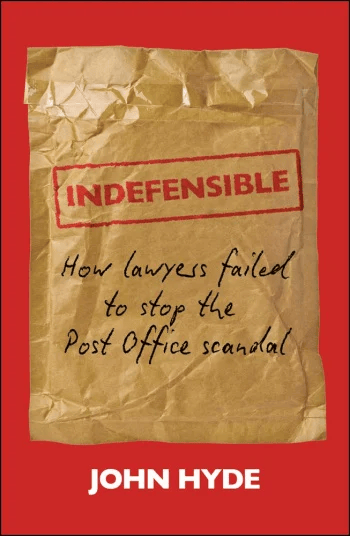
Rosie Brocklehurst reviews Indefensible: How lawyers failed to stop the Post Office scandal, by John Hyde, published by Bristol University Press.
The Horizon Post Office scandal is one of the biggest cases of injustice in recent British legal history. Many journalists reported on the story, but there are four journalists who should be singled out for the sheer persistence, scale of coverage and skill they have shown in bringing the story to public attention: Nick Wallis, a broadcast journalist and presenter, formerly at BBC Radio Surrey who is now freelance; Richard Brooks, who writes “In The Back” for Private Eye; the much-admired Karl Flinders of Computer Weekly and John Hyde of The Law Society Gazette.
John Hyde has now written a book that focuses on the role lawyers played in the story. In particular, Hyde examines the tensions and errors that can arise when corporate lawyers put the needs of the business above their duties towards the law. In their journalism, these four acknowledge each other’s work and are assiduous in thanking Rebecca Thomson, who wrote the first ever story about the scandal in Computer Weekly back in 2009.
For the past half a dozen years, Hyde, with the support of his editor, has written many impactful articles about the scandal in the Law Gazette.
The magazine serves lawyers and is given to qualifying solicitors as a necessary perk of the job. Hyde, who is not himself a lawyer, is writing about the ethical failings in a profession that employs him. This might be thought challenging, but it positions him perfectly to write about the culture and ethics of the corporate lawyer. The Horizon Post Office scandal has given him unparalleled insight and a hugely important body of evidence from which to raise important implications for the profession.
Of course, while Hyde is in a strong position to inform, educate and influence his lawyer audience, the law itself has to be followed in any written scrutiny especially when there is a police investigation going on.
Sir Wyn Williams who led the statutory public inquiry is expected to deliver his final report within the next six months. Some of the perpetrators may then be arrested and charged with crimes.
For many Subpostmasters this can’t come too soon. Most victims were terrorised by out-of-control investigators with the power to ensure prosecutions followed. But investigators were not lawyers – although they worked with lawyers and they set the tone for what followed, within an organisation that let them act with impunity. Investigators had no interest in the facts of Horizon’s failings or the good standing of Subpostmasters. Fortunately, good journalists and some humane, honest lawyers such as Barrister Paul Marshall and Flora Page KC and Neil Hudgell have worked on behalf of Subpostmasters, often doing the work pro bono.
Many victims of the scandal want the culpable to be named, shamed and prosecuted before Subpostmasters get too old. The scandal began in 1999. Twenty-seven years later, over 250 Subpostmaster victims involved have died without redress. Others, such as Janet Skinner, another Subpostmaster who was imprisoned and who became paralysed while locked up, are hoping that time spent will mean a thorough job is done and none of the guilty are overlooked.
All journalists need to be alert to the laws of libel and contempt, not just to avoid financial penalties that could ensue, but because of the risk of prejudicing any court cases that may be brought. In terms of the Horizon Post Office scandal, it is crucial that nothing written could be viewed as prejudicial. It was announced at the end of September, that the police in Operation Olympos have been granted the money they had requested to conduct their investigations into the scandal properly and recruit the officers they need. Olympos will focus on offences of perjury and perverting the course of justice.
In 2019, Hyde first came across the story about the unreliability of Fujitsu’s Horizon computer system which had been rolled out from 1999 onwards, to 17,000 post offices across the country. That was the year the extraordinary Subpostmaster Alan Bates took the civil Group Litigation to the High Court for 555 Subpostmasters.
But as Hyde explains in his book, he as a journalist, did not fully understand the full meaning of this story until 2021, when he spoke at length to Lee Castleton, the Bridlington Subpostmaster (played in January 2024 by Will Mellor, in the ITV Drama Mr Bates Vs the Post Office). Castleton possesses an extraordinary kindness, warmth and humility which comes over in his press interviews. When Hyde refers to Castleton talking about his belief in the British justice system, there is a palpable sense of innocence at the core of this man, about a system in league with the Post Office, that bankrupted him and ruined the health of his wife Lisa and his daughter Millie.
Lawyers played their part in his ruin. And it is the human interest that galvanises the journalists who have helped bring the story to public attention. It is lack of human interest that has destroyed codes of ethics that should be unbreakable within the justice system in whatever incarnation – corporate lawyer or none. Does belonging to a company mean that ethics automatically take second place?
In an interview to publicise his book, Hyde was asked by legal affairs journalist Joshua Rozenberg if he could name lawyers who, in his view, deserved most of the blame. Hyde answers yes but then proceeds without naming anyone specifically. That is undoubtedly the dilemma he and others find themselves in, in writing about legal culpabilities prior to the police bringing charges and Sir Wyn Williams’ final report.
What Hyde is able to do is to raise multiple issues and give examples from what is publicly available, about what the scandal says about corporate lawyers and the ethics that the story holds for others working in-house. Hyde is able to write about lawyers interviewed at the statutory public inquiry he attended regularly, such as the witness testimony given in person by Jarnail Singh, Post Office Ltd’s in-house solicitor. This has to be one of the most risible and shameful performances ever conducted in plain sight of a retired Judge and numerous KCs, with Subpostmasters he helped to jail, sitting in the room.
Hyde also writes about leadership within the Post Office. It would be too easy perhaps to put the lower ranks only in the frame and scapegoat them. Paula Vennells tried it, however, saying she had been given bad advice and she names five people she employed.
However, if corporate lawyers appear to act in this story to second-guess what the leader of the business indicated he or she wanted to hear, then we must also focus on what those leaders said and did – those on the Board, the various Chairs, the CEO who was paid the most, the representative from Government UKGI (UK Government Investments) based within the Treasury. These were not lawyers, but they ordered lawyers to advise Post Office Ltd (PoL).
They agreed to the payment of millions of pounds of taxpayers’ money to defend the Group Litigation Order case and take on prosecutions. In writing about what Paula Vennells may or may not have known, Hyde also spotlights Vennells’ criticism of her own legal counsel, Susan Crichton. Astonishingly, Vennells complains that Crichton put her legal duties ahead of her loyalties to the business.
Hyde does not refer to the 2011 instance, when relatively new to the business, Vennells wrote to the then PoL chair, Alice Perkins, about how she had managed to excise a criticism of the Horizon system from the Royal Mail’s stock exchange prospectus, saying how, “I have earned my keep”. This was one year after pregnant Subpostmistress Seema Misra had been sent down and a year after Moya Greene had been made CEO of Royal Mail to oversee its privatisation. Years later, Moya Greene was to write to Vennells about the truth of Horizon’s unreliability and prosecutions being unsafe, saying to Vennells :“I think you knew.”
Enormous damage was done and lives ruined by PoL’s pursuit of money which had never been lost. Enormous damage has been done to the reputation of the legal profession through this most high profile of scandals. Hyde says most lawyers are ethical. It was therefore honourable that he does not shy away from mentioning the involvement of Lord Grabiner and the former President of the Supreme Court, Lord Neuberger, in advising PoL to seek to recuse Justice Peter Fraser during the GLO trial, thus delaying it and costing Alan Bates’ litigators even more money. One can only presume at that level of connection, that UK Government Investments, who, ultimately, are in charge of PoL, were in the know and in agreement with this move.
It is extraordinary to see the most powerful and celebrated lawyers in the land attempting to shut down the civil case brought by 555 Subpostmasters and their defenders on the grounds that the judge was biased. Justice Coulson threw this out in no uncertain terms on appeal, and even then there was a PR exercise to whisper about Fraser and Coulson’s connections with each other. Both Grabiner and Neuberger have kept a low profile on the issue ever since. Neuberger was not called to the Inquiry. One has to question this. It was bad advice. It was bad law. But they got paid.
The total figure so far paid for lawyers to defend the Post Office or pursue Subpostmasters, paid out of the public purse, is £335 million as of September 2026.
Hyde reminds us that back in 2013 , knowledge was emerging via the ‘Clarke advice’ of unsafe prosecutions. This arose from knowledge about the manipulated evidence of Fujitsu’s ‘expert witness’ and architect of Horizon, Gareth Jenkins back in 2010 in the Misra case, and in five other cases, all done without him having his legal duties explained. Failure to disclose documents to the defence was also a smoking gun in the Misra case. Doubts about Horizon’s infallibility arose from Second Sight. These were Forensic Accountants, a two-man outfit brought in by Crichton and PoL and agreed by Vennells, to put the whole issue of Horizon’s unreliability to bed rather than open a can of worms. But they did the opposite, although they provided the phrase useful to PoL about Horizon’s unreliability, that it “was not systemic”. It was not proven to be systemic back then, but then they were only just getting to grips with the sheer scale of this horror story.
Their investigations were, unsurprisingly, cut short. By the time Susan Crichton was kept out of a Board meeting by Vennells and Chair Alice Perkins, and then left the business, and also when Second Sight were shown the door a few months later, many more people within PoL including its lawyers and its external hired lawyers were working to suppress the truth of what they knew about unsafe prosecutions and the complete lack of robustness of Horizon. Andrew Parsons who worked for the legal firm now known as Womble Bond Dickinson, gave advice quite deliberately to suppress, and the solicitors Herbert Smith Freehills, who have so far been paid an estimated £202 million for their work, knew that anything that supported the view that unsafe prosecutions had taken place, which had resulted in imprisonment and suicide of Subpostmasters, had to be completely rebutted for the sake of the business and for the continuance of their fees.
One of the least known aspects about Alan Bates, now Sir Alan, is that in his pursuit of justice for Subpostmasters, he virtually ignored what journalists and PR could actually do for the cause. Nick Wallis acknowledges this. Bates’ attitude was indicative of a wider distrust that laymen have about the vocational values and professional motives of journalism. Journalism, like the law is subject to the law. But in journalism, there is a measure of self-regulation through such bodies as IPSO.
Of course, in journalism unlike medicine, there is no professional code which states, “First, Do No Harm”. But without the journalists mentioned here, it would be difficult to see how justice at any scale would ever have been reached in this story. The lawyers involved, left to their own devices would have covered it up. Yes, there is the Bar Council and the Solicitors Regulation Authority, but the SRA has been heavily criticised. Yes, there is a Lady Chief Justice, but if she had had her say there would have been no Parliamentary overturning of convictions and convicted. Subpostmasters would not have been able to apply for compensation for years because of the logjams in the justice system. Some playwrights and TV companies might argue that without ITV’s drama about the scandal, momentum would have dwindled on both compensation and the convictions being overturned. In the end, it is wide public outrage that makes the difference.
These journalists are most honourable actors in this story and deserve gongs. Wallis for example may have been paid for his book, but with the help of his publishers, set up a charitable fund to which financially hard-pressed Subpostmasters could apply to pay rent and bills. Working for the Law Gazette is not the most highly paid job, as I am sure Hyde would attest, but it is a hugely important job, because what it says may make those who need to do so, sit up and listen, and also some of those who have the power to do so, to reform the law. To that end, it is satisfying to know that the Chair of the Law Commission, charged with Law Reform recommendations to be enacted eventually by Parliament, is Sir Peter Fraser himself, and he is due to report on reforms next year.
John Hyde has written a most valuable and important book.
Rosie Brocklehurst is a journalist and press officer (retired) who worked for the Labour Party, LWT, the BBC and several charities.