
As Britain prepares for the possibility of war, former military commanders are portraying legal scrutiny as a threat to national security. The argument carries a dangerous implication, argues Simon Pearson.
On Saturday, Wes Streeting told the country that Britain had a little over a thousand days to prepare for war. His warning in the Telegraph was directed at a danger that is neither imaginary nor confined to the manoeuvres of politicians seeking larger budgets. Russia continues to attack Ukrainian cities, and European states have good reason to examine their capacity to withstand a prolonged conflict. Britain’s armed forces need equipment that works, an industrial base capable of sustaining them and a government willing to take decisions about what they are for.
The argument over their readiness has nevertheless acquired an ugly accompanying demand. Increasingly, those who question the conduct of British Special Forces are being treated as though they are weakening the country’s defences simply by asking for an account of what happened.
In a Spectator interview with Tim Shipman, former SAS commanding officer Richard Williams offered a particularly extravagant version of this case. He suggested that legal challenges could do more to cripple British Special Forces than the IRA, al-Qaeda or Russia had ever managed. The lawyers and processes examining military conduct were, in his telling, vulnerabilities that Britain’s enemies might exploit. Then came a remark about funding: he could only imagine where the money behind such efforts came from. He supplied no evidence of hostile financing, nor did Shipman ask him to. A former commander had invited listeners to suspect that investigations into British soldiers might be serving foreign interests, and the suggestion was allowed to stand.
The implications are hard to miss. A family seeking answers about a killing may have to contend not merely with military secrecy and the cost of legal proceedings, but with the insinuation that its efforts assist the country’s enemies. Williams does not allege a specific conspiracy. That is part of the usefulness of the suggestion: suspicion is created without the burden of naming the people involved or proving their intentions.
The immediate controversy is Operation Tanglement, the Royal Military Police investigation arising from a night-time raid in eastern Syria in July 2022. Five SAS soldiers were investigated on suspicion of murder after two teenagers associated with Islamic State were shot dead during an operation intended to capture a senior militant.
The soldiers said they believed they were under fire and had acted to protect themselves. No weapons were recovered from the dead. Senior officers in the regiment accepted the soldiers’ account, but General Sir Gwyn Jenkins, then Director Special Forces, decided the matter needed further investigation. Questions about the absence of weapons and the force used had not been resolved by the regiment’s own approval. In September 2023, the investigation also extended to three SAS officers over the handling of evidence. By May 2025, the Service Prosecuting Authority had decided not to bring charges against any of the eight men.
Those decisions by prosecutors are now being made to carry a weight they cannot bear. A decision not to prosecute establishes neither that there was no reason to investigate nor that the referral was an abuse of power. Williams thinks Jenkins’s decision was a public-relations exercise undertaken in the shadow of Panorama’s reporting on Afghanistan. He says it ‘appeared’ to be about reassuring Whitehall, rather than assessing military conduct. Yet his explanation rests on an impression of Jenkins’s motives. It does not tell us what Jenkins knew when he made the referral, what advice he received or why the circumstances did not warrant independent scrutiny. The subsequent failure to secure a prosecution cannot answer those questions retrospectively.
The Sunday Times disclosure about the three officers makes the distinction more important. They were reportedly investigated over suspected perverting of the course of justice, apparently relating to the handling of evidence, although the precise allegations have not been made public. One account raised questions about access to material collected by the Americans, possibly including drone footage. That account does not establish that anyone unlawfully withheld anything, and none of the officers was charged. It does establish that the investigation reached beyond the soldiers’ split-second decisions in Syria.
Whatever danger the soldiers faced that night, the handling of records and requests for evidence happened afterwards. It cannot be justified or condemned by describing the battlefield as dangerous. The police needed to find out whether they could obtain the material necessary to investigate the deaths.
This is where the defence of the regiment’s reputation becomes a defence of its power to judge itself. Williams describes an institution whose internal standards are so exacting that fellow SAS soldiers are the severest critics of anyone who fails them. Shipman supplies the phrase “self-policing environment”. The point is made with confidence, almost as though the closeness of the regiment’s members guarantees the independence of their judgments. It does not. Soldiers who depend on one another in combat will naturally form powerful loyalties, and some of those loyalties may be the basis of their effectiveness. When the allegation concerns the conduct of colleagues or commanders, however, those relationships create a problem for the institution making the judgment. No one needs to imagine universal dishonesty to see it. Police forces and intelligence services have struggled with the same question: who decides when an accusation must leave the organisation and be examined by someone who does not owe it loyalty?
The Afghanistan inquiry has already heard evidence of the practical consequences. In May, a former Special Forces chief of staff told the inquiry that he believed earlier allegations had not been referred to military police because an investigation risked disrupting operations and damaging morale. Regimental rivalry also figured in his explanation of decisions taken in 2011. The inquiry has not delivered its final findings, and the witness’s account cannot be treated as a judicial determination of why every decision was made. It does, however, describe an institutional incentive to keep potentially grave allegations away from independent investigators.
Morale, a concern now repeatedly offered as a reason to stop scrutinising the SAS, had also been cited as a reason why earlier scrutiny did not happen. Haddon-Cave’s inquiry concerns alleged unlawful killings during detention operations in Afghanistan and the possibility that evidence was concealed or police investigations mishandled. Its work depends upon military records to which bereaved families and outside investigators have never enjoyed ordinary access.
Earlier this month the inquiry disclosed that it had obtained around 10,000 photographs associated with detention operations that did not appear to have been included in earlier police investigations. The Ministry of Defence also identified around 97 million previously unidentified documents for its disclosure processes. Their number does not prove concealment, and many may ultimately have no bearing on the allegations. But it tells us something about the enormous disparity between the institution that holds the evidence and those attempting to establish what its personnel did. An officer may insist that an allegation was properly handled. The documents needed to test his assurance remain largely in the hands of his employer. Under those conditions, the power to withhold or delay information matters at least as much as the formally declared willingness to co-operate.
Williams would have listeners believe that legal procedures designed to investigate these events have become instruments of harassment. His account of human rights law is especially revealing. He says, according to the uncorrected transcript, that there are ‘no human rights’ between armed combatants trying to kill one another. It is true that the law permits attacks on military targets in circumstances where peacetime law would not permit violence. It is not true that legal protections simply vanish on a battlefield. As the International Committee of the Red Cross explains, international humanitarian law and human rights law continue to apply during armed conflict, albeit in different ways. People who surrender or are otherwise placed outside combat cannot simply be killed, and the protection of civilians is not an optional concession to modern sensibilities. The law also recognises that a soldier’s reasonable assessment under fire may differ from what later becomes clear in an investigation. That is why evidence about the circumstances is necessary.
Williams passes from Syria to Iraq, Afghanistan and Northern Ireland without giving their different legal settings much weight. Northern Ireland was an internal security operation in support of the civil authorities; it was not merely another overseas battlefield. The distinction is central to the families whose relatives were killed by soldiers operating among the civilian population of the United Kingdom. The Good Friday Agreement did not conjure a duty to investigate suspicious deaths out of thin air. Allegations involving the security forces, including collusion and the use of lethal force, long preceded it, as did families’ struggles for disclosure. Human rights procedures offered routes through which the state could be challenged for failing to investigate adequately. For Williams, the growth of those protections marks the beginning of a damaging legal culture. For many families, the long-standing problem was how little information the authorities had been prepared to release.
The current Northern Ireland Troubles Bill gives this argument an immediate political purpose. Intended to reverse provisions of the previous Conservative government’s Legacy Act, the legislation has already been amended following pressure from veterans’ organisations. Under the government’s October proposals, consent from the Attorney General would be required before certain serious Troubles-related prosecutions could proceed.
Ministers argue that such decisions would be taken independently in a quasi-judicial capacity. That claim does not eliminate the problem created when a UK law officer acquires an additional say over prosecutions concerning alleged wrongdoing by agents of the state. Nor does the understandable desire to prevent pointlessly repetitive investigations determine whether a particular family has ever received a meaningful one.
The balance between Westminster’s authority and prosecutorial independence in Northern Ireland is being altered in the name of protection for those who served. Even so, the SAS Regimental Association has threatened a legal challenge unless it receives stronger safeguards. Williams tells Shipman that more than 250 SAS veterans face investigation or the prospect of being called into proceedings. The number is striking, but his explanation bundles together situations that ought to be separated. An active suspect, a witness and a former soldier who may be asked to answer questions about a decades-old incident do not occupy the same legal position. Anyone using that figure as evidence of persecution should first establish how many people fall into each category, what the cases concern and how many have already been investigated.
Phil Shiner appears in the interview, too. The solicitor was struck off in 2017 following serious findings of misconduct connected to litigation over Iraq. Those findings deserve to be taken seriously; the regulatory record is not a fiction. They cannot invalidate every later allegation about Afghanistan, Syria or Northern Ireland. Shiner’s disgrace supplies a convenient substitute for examining the underlying evidence in cases with which he had nothing to do. It is a familiar way of discrediting scrutiny: identify a discredited claimant and allow his name to contaminate everybody else.
Williams then places the argument inside Britain’s relationship with the United States. He says the SAS and SBS provide Britain with something approaching numerical parity with America’s most specialised counter-terrorist forces, allowing the two countries to pool personnel and intelligence. The figures are his, and public information about these secret units is insufficient to treat a claimed equivalence of squadrons as an independently established fact.
More telling is his forecast that Washington could come to regard British Special Forces as unreliable because of the burden of legal scrutiny. He provides no evidence that American commanders have reached that conclusion. Yet once accountability has been recast as a weakness in the transatlantic alliance, it becomes possible to portray scrutiny of a killing in Syria as a threat to the country’s standing in NATO. A legal question has been inflated into a problem of strategic credibility.
The same movement is visible in the intervention of former Army chief General Patrick Sanders. At last week’s parliamentary hearing on rearmament, reported by the Telegraph, he described an Army short of depth, training opportunities and the equipment needed to sustain a prolonged war. Those problems are substantial. Britain cannot make them disappear with patriotic speeches. Sanders nevertheless connected military readiness to the supposed “pernicious effects of lawfare” and warned that soldiers would lose confidence if they felt the country did not have their backs.
Here again, an obligation to equip and support service personnel is extended towards an argument about shielding them from the legal consequences of their conduct. Soldiers are entitled to competent and timely investigations, protection against malicious accusations and proper care after service. They cannot be promised that serious allegations will disappear because their work is difficult or dangerous.
Sanders also wants a credible route to defence spending of 3 per cent of GDP by 2030. His complaint that industry lacks a sufficiently clear ‘demand signal’ tells us something about the economic interests behind the rearmament debate. Arms manufacturers need contracts long enough to justify investment; military leaders want forces whose ambitions are not continually thwarted by Treasury settlements. Ahead of Chancellor John Healey’s Budget on 28th October, those demands are colliding with the government’s other spending commitments.
Reuters reported in September that the Office for Budget Responsibility estimated the cost of reaching 3 per cent by 2030 at an additional £17.3 billion annually. The figure matters, as does the political choice it describes. A country can face a real security threat while also having defence contractors pressing for favourable commitments and former commanders defending their institution’s autonomy. The existence of the threat cannot settle who should receive public money or how much oversight should accompany it.
These decisions will be made while the cost of housing remains punishing and public services are asked to absorb financial constraints that appear almost permanent. The Conservatives have proposed cuts to welfare to help fund military expansion. Labour says security need not come at the expense of social provision, although its own ministers acknowledge that greater defence expenditure means choices elsewhere. Workers are being asked to finance the armed forces and, in the event of war, may be asked to join them. It would be remarkable if this obligation came with a diminished right to know what those forces do. Democratic control is not a luxury for peacetime, something to be restored once the dangerous work is finished.
Another former Director Special Forces, Lieutenant General Sir Graeme Lamb, offers a considerably more thoughtful account of what service in war demands. Interviewed by Roland Oliphant for the Telegraph, Lamb says the law of armed conflict is an absolute limit on military conduct. He accepts the fear and confusion in which soldiers often act, but insists that those pressures do not amount to a general excuse. He is less concerned with asserting the regiment’s superiority than with explaining what it means to maintain a legal and moral standard while exercising organised violence.
Williams’s description of the SAS’s internal discipline is not itself an answer to Lamb’s central question: what happens when the people involved fail to meet that standard? Lamb supplies a disturbing hypothetical about an airstrike. Three enemy fighters enter a building occupied by 25 people. Under the assessment he describes, the strike may be authorised even though 22 other people could die. He calls that decision colder than a frightened soldier making a mistake during a raid. There is a danger in the way such calculations are discussed, as though an estimated number of civilian deaths were a licence that could be used up.
International humanitarian law requires commanders to consider the concrete and direct military advantage anticipated, the expected incidental civilian harm and feasible precautions. The numbers alone cannot show whether the hypothetical attack would be lawful. Lamb’s example nevertheless brings an uncomfortable reality into view: the apparent precision of a strike may depend on a decision, made far from the site, that a certain level of foreseeable civilian death is acceptable. It also shows why the people who authorise campaigns should not be able to deposit the entire moral burden on the soldier who executes their orders.
Lamb remembers wishing he had taken visiting parliamentarians to see the aftermath of an actual strike, so that their discussions of military operations had to reckon with what the explosions left behind. That is an altogether more serious starting point for accountability. Ministers decide where soldiers are sent, approve the objectives and authorise the use of force. Commanders turn those decisions into orders, sometimes using intelligence that later proves incomplete or wrong. Individual soldiers remain responsible for their actions, but scrutiny that never climbs the chain of command offers only a partial account of how military violence is organised. It suits the state to celebrate courage at the sharp end while leaving the decisions made further up the hierarchy behind a screen of official secrecy. Lamb’s argument makes it harder to do that, even if he is not addressing the specific allegations that now face the SAS.
That responsibility extends to the political leadership now demanding that Britain prepare for war. According to the United Nations Human Rights Monitoring Mission, at least 328 Ukrainian civilians were killed and 2,105 injured in September 2026, a sharp increase on the same month the previous year. Russian missiles and drones continue to strike residential areas and civilian infrastructure. In Kherson, reports of operators using small drones to hunt people in the streets show how new technology can make the individual civilian a target.
These are actions by an invading military engaged in an imperialist war, not events equivalent in scale or circumstance to the allegations concerning British Special Forces. Their relevance is simpler, and less comfortable for those who want legal scrutiny weakened at home. We cannot insist that Russian violence be documented and investigated while portraying the investigation of British military actions as inherently disloyal.
Williams’s invocation of Russia almost reverses that logic. The external enemy’s real violence becomes the backdrop against which British lawyers and investigators are accused of inflicting greater harm. An innocent soldier can quite reasonably dread a lengthy, badly handled investigation. That is an argument for competent investigators and timely decisions, not for allowing the regiment to determine which killings are examined. Whether an institution has made a mistake, or something worse, cannot be decided in advance by the institution itself. Nor can the government decide that pursuing it is too costly to the country’s prestige. The very power to take lives is why military decisions must remain open to examination by people who have not already sworn loyalty to those who made them.
The recent flirtation with military-coup rhetoric among some public defenders of the SAS gives this attitude a particularly unpleasant edge. Such remarks do not establish an organised plot, and a journalist should not pretend they do. They do reveal the direction in which a romantic faith in the armed forces can travel when civilian politicians, lawyers and investigators are depicted as obstacles to national survival. The men authorised to use force begin to appear as the only people fit to govern. That is an attractive fantasy for anyone who imagines that discipline is more valuable than public consent, but it leaves workers and everyone else with fewer means to challenge power, not more.
I would rather live in a less safe country where credible allegations of war crimes are investigated than in one whose military enjoys practical immunity because its commanders are considered indispensable. The evidence that accountability is making us less safe has not been established; the claim is being repeated much more often than it is being demonstrated. Even if a properly conducted inquiry imposes costs on an operation or an institution, that cannot be the end of the matter. Courts are sometimes inconvenient to governments, and Parliament can be inconvenient too. That is part of the point of having them.
The difficulty of obtaining records and questioning witnesses cannot justify allowing the institution holding those records to settle the allegations against itself. Britain does need armed forces capable of responding to actual threats, and Russia is supplying ample evidence of why. But a military whose standing depends upon investigators knowing when not to ask questions would be a poor guardian of the freedoms invoked on its behalf.
Williams’s interview invites listeners to look at the relatives of the dead, at legal challenges and at the officers who referred allegations to police as sources of national weakness. The people who were killed slip out of view; the damage done to the regiment takes their place.
A country that is preparing for war ought to be exacting about the powers it hands to those authorised to kill. It cannot afford to let the phrase ‘national security’ become the answer to every question it is frightened to ask.
Simon Pearson writes at Anti-Capitalist Musings on Substack, where this article first appeared.
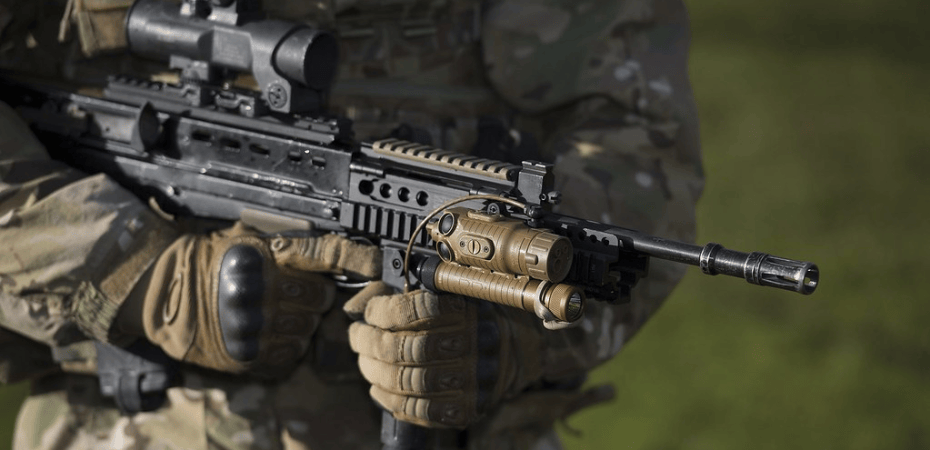
Image: “An upgraded Laser Light Module Mk 3 mounted on the SA-80 Mk2.” by Defence Images is licensed under CC BY-SA 2.0.

