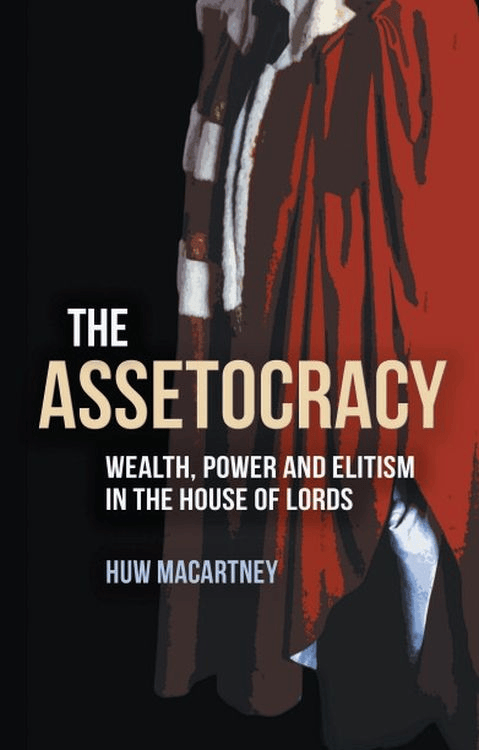
By Huw Macartney, whose new book on the financial and political activities of members of the House of Lords is published this week.
Two Labour governments, first under Tony Blair and then under Keir Starmer, have brought about the biggest changes to the House of Lords in over a century. The removal of the last remaining hereditary peers in May 2026 marked the final stage in dismantling the centuries-old dominance of the landed aristocracy over Britain’s second chamber. In principle, this was supposed to herald a more diverse, representative and meritocratic institution. But has the removal of hereditary privilege really made the House of Lords any less elitist?
This was one of the central questions that a team of researchers and I set out to explore. Over nearly two years, we compiled what is, to the best of our knowledge, the largest existing repository of the financial and political activities of members of the House of Lords. Our conclusion was striking: a new economic elite – an assetocracy – has increasingly replaced the aristocracy of the past. The findings are published in my new book, The Assetocracy: Wealth, Power and Elitism in the House of Lords.
Following the 1999 reforms, Tony Blair did indeed succeed in rebalancing the chamber through a substantial number of Labour appointments, while also bringing about modest improvements in its social composition. For a time, the historic relationship between wealth and political power appeared to be weakening.
Following the formation of the Coalition government in 2010, however, successive Conservative prime ministers increasingly filled the chamber with wealthy shareholders and individuals holding multiple directorships in major private companies.
Although often associated with the ‘new money’ of modern finance and business, members of this emerging assetocracy display a remarkable degree of continuity with the old aristocracy. Compared with the Lords as a whole, a greater proportion were privately educated, attended one of the elite Clarendon schools, and passed through Oxford or Cambridge. Moreover, alongside their substantial shareholdings and company directorships, this elite was also more likely to own land and farms and receive income from rental properties (see figure below).
In short, rather than displacing the old aristocracy, the new assetocracy has largely reproduced its patterns of wealth, privilege and social exclusivity, combining the traditional advantages of land and property ownership with the financial riches of modern (rentier) capitalism.
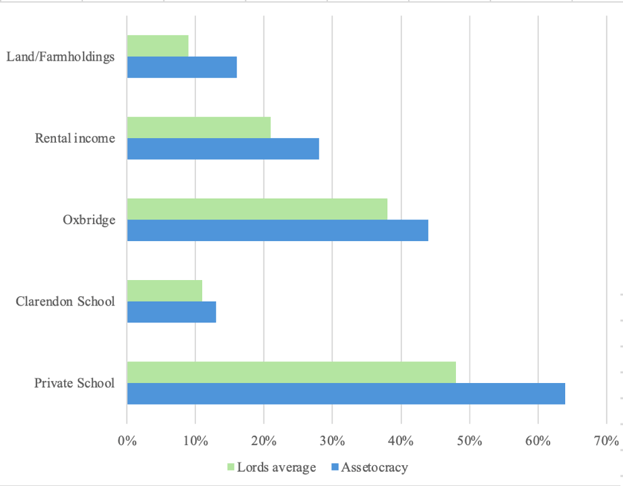
Figure: Comparison of the assetocracy and the House of Lords average across education, landownership and rental income.
The book makes a series of recommendations arising from these findings. Perhaps the most important is also the most obvious. For decades, studies have highlighted the extraordinary degree of power enjoyed by prime ministers in determining who enters the Lords and how many peers are appointed. Yet successive governments have failed to address this fundamental weakness.
Under David Cameron and Boris Johnson in particular, this power helped facilitate the appointment of growing numbers of wealthy individuals from the worlds of business and finance. The result is that the valuable work the Lords often performs is increasingly overshadowed by concerns about the concentration of economic privilege within the chamber.
The current Labour government should therefore take the decisive step of transferring responsibility for appointments away from the prime minister and into the hands of a strengthened, genuinely independent House of Lords Appointments Commission. This would not eliminate economic privilege from the chamber, but it would help prevent successive prime ministers from using appointments to reproduce it.
Labour deserves credit for finally ending the hereditary principle in the House of Lords. But it would be a grave mistake to imagine that the job of reform is now complete.
Huw Macartney is Associate Professor in Political Economy, University of Birmingham. He is the author of four books, including The Assetocracy: Wealth, Power and Elitism in the House of Lords (Agenda, 2026). He will discuss his findings and the book at an event at University of Birmingham on 29th October.