
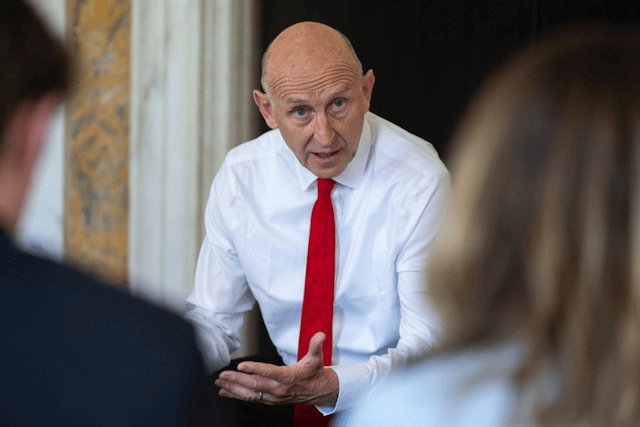
Here are some measures that should definitely be in John Healey’s speech.
Ahead to tomorrow’s Budget the political and parliamentary lead for the Right to Food Commission, Liverpool West Derby MP Ian Byrne, has called on the government to prioritise immediate relief measures to assist those people across the country who are quite literally going hungry.
Ian Byrne MP said: “Systemic state failure has resulted in over 14 million people in this country who are food insecure and unable to adequately feed themselves and their families. These people live in my constituency, the Prime Minister’s and the Chancellor’s.
“When I became an MP, just like the PM I set myself a test. My West Derby test has, since I became an MP, led me to campaign relentlessly for a right to food and end hunger in this country. Not one person in my constituency and across the country should be struggling to feed themselves and their families, yet millions are in this situation and it has to end.
“If the PM is to pass his own Makerfield test he must start to end hunger in this country. There is no greater test of what type of government you want to lead than to ensure people are not going hungry. The PM and his Chancellor must signal their intent tomorrow with measures that provide immediate relief to those people who are struggling and they must avoid falling into a trap of tinkering around the edges.
“In our recently published report, the Right to Food Commission set out a range of policy measures that must be introduced to ensure people can eat well. Helping them and saving the public purse at the same time.
“The economist Prem Sikka has calculated that some immediate relief measures, including universal free school meals, support during school holidays and funding for public diners, would cost £7.8bn, in addition to existing government expenditure.
“Universal free school meals and universal holiday food provision, and funding community kitchens and hubs, is approximately £6 billion in addition to existing and committed government expenditure. In addition, the recommendation to scrap the five-week wait for receipt of Universal Credit is estimated to cost around £1.8 billion, an investment that will reduce debt and the associated burden.
“This money could be raised by tax reform that does not affect the fiscal rules. For example aligning capital gains tax with income tax could alone raise £12 billion to £14 billion. If we aligned taxation of dividends with income tax rates it would raise a further £6bn.
“We at the Right to Food Commission urge the PM and the Chancellor to listen to the Right to Food Commission report, understand the sobering reality of food insecurity in this country and implement our recommendations. If they are serious about helping to address the cost-of-living difficulties facing people (and we think and hope they are) then radical, substantive action to end food insecurity and hunger in this country must start tomorrow.“
Read the Right to Food Commission report here.
Women spend over half their income on rent
Women in the UK spend, on average, 57% of their earnings on private rent, compared to 41% for men, according to new analysis by the Women’s Budget Group of Office for National Statistics earnings data. The figures reveal a stark 16 percentage-point gender gap in housing affordability and underline the growing pressure facing women amid rising living costs.
The analysis shows that private renting is unaffordable for everyone, with both women and men spending well above the widely accepted affordability threshold of 30% of income on housing costs. However, women face a significantly heavier burden. Lower earnings, driven in large part by women’s disproportionate responsibility for unpaid care, mean they have less income available to meet rising rents and other essential costs.
Key findings
- Earnings are not keeping up with private rents. In the UK, women see on average 57% of their median earnings absorbed by rent, compared to 41% for men (across all properties).
- For a one-bedroom property this figure stood at 46% for women in the year to April 2026 and at 34% for men.
- This comes to a gender housing affordability gap of 12% for a one-bedroom flat in the UK.
- This is even higher for two-bedroom properties, where the gap stands at 14% (52% of women’s earnings v 38% of men’s earnings).
- The situation in London is especially acute, where a woman renting a two-bedroom property could expect to see 69% of her earnings absorbed by rent as of April 2026. For men renting in the capital, this figure is 55%.
- The average rental price of a one-bedroom property in the UK has gone up from £1,082 in April 2025 to £1,121 in April 2026, £39 per month or £468 per year.
- In July 2026, Crisis and Citizens Advice estimated that fewer than 2% of homes listed for rent in Great Britain could be covered by LHA alone.
Three years of frozen housing benefit, combined with cuts to social security and public services over the past decade, have further eroded women’s financial resilience. At the same time, households are facing renewed pressure from rising food and energy bills, with single-parent families, most of whom are headed by women, among those hardest hit by growing levels of energy debt.
Ahead of the Autumn Budget, the Women’s Budget Group is calling on the Chancellor to permanently re-link Local Housing Allowance to local rents, raising it to the 50th percentile to ensure housing support keeps pace with private rents and protecting vulnerable households from homelessness.
Unfreeze housing benefit
- An Equality Impact Assessment carried out by the DWP in 2020 noted that, of housing support claimants who had a shortfall between their rent and housing benefit, 52% were single women (as opposed to 18% single men and 30% couples).
- While it is difficult to estimate the proportion of women receiving Housing Benefit as it is based on household characteristics, 52% of Housing Benefit recipients are in single-female-headed households, and 11% are in couple households (many of which will include women).
- Around 57% of tenants on Housing Benefits are women.
Erin Mansell, Deputy Director of the Women’s Budget Group, said: “The Chancellor committed to give families breathing space at his first Budget, but that promise will ring hollow if it fails to act on housing costs. Local Housing Allowance has been frozen while rents have surged, leaving some of the most vulnerable private renters, particularly single parent households, facing an impossible gap between support and reality.
“Because women continue to earn less than men on average, largely due to unequal caring responsibilities, they spend a greater share of their income on housing. For the same reason they are also more likely to rely on housing support, making up the majority of housing benefit claimants. As rents soar and support fails to keep pace, many women are being pushed closer to financial brink.
“This comes at a time when households are facing renewed pressure from rising food prices and energy bills. Single-parent families, the vast majority of whom are headed by women, are bearing the brunt of the energy debt crisis. Every pound spent covering the shortfall between rent and support is a pound taken away from essentials.
“Re-linking Local Housing Allowance to at least the 30th percentile of local rents would give private renters real security and ensure housing support reflects the true cost of renting. Single mums already make up the majority of statutory homeless families. Without bold action, gender inequalities will deepen, leaving more women and children at risk of poverty and homelessness.”
Increase maternity pay too
The Women’s Budget Group, while welcoming measures on expanding paternity leave, are also urging Chancellor John Healey to increase maternity pay as well. It recently published a cost benefit analysis of improving maternity pay which finds that strengthening maternity pay would put more than £1 billion into families’ pockets while delivering wider benefits for employers, children’s outcomes and maternal mental health.
Dr Eva Neitzert, Head of Research and Policy at the Women’s Budget Group said: “We’re pleased to see the Chancellor recognise cost of living pressures on families and carers in his package of pre-announced measures. The lack of statutory paternity pay for self-employed fathers was a massive gap in parental leave support putting financial pressure on families when they should be focused on mothers recovering from birth and both parents caring for and bonding with their new baby.
“We hope the Chancellor will go further in his cost of living Budget and increase statutory maternity pay as well. State support for new mums still sits at less than half of minimum wage beyond the first six weeks. Our cost benefit analysis of extending this to twelve weeks and raising pay to the national living wage found it was a net positive to the exchequer and would make the world of difference to families in the first nine months of their children’s lives.”
An Unashamedly Female Agenda: A Political Economy for Women
In a separate initiative, a group of female Labour MPs from the 2024 intake have released a set of essays called An Unashamedly Female Agenda: A Political Economy for Women, available here.
The collection, written by almost a dozen MPs with the Women’s Budget Group and the Good Growth Foundation, calls on the Labour Government to put women’s engagement in the economy at the heart of Labour’s economic and industrial strategy.
Analysis from the Women’s Budget Group shows that the UK economy loses out on £113 billion gross value added every year because women are excluded from paid work on equal terms to men.
The essays argue that this is failure of design rather than an accident, and that the problem is getting worse. When analysis was first conducted in 2023, the figure stood at £88.7 billion. More than a quarter of working-age women are economically inactive – a rate persistently and substantially above men’s.
They write that some regional economies forgo close to a tenth of their entire annual output through the exclusion of women from the labour market, and the burden falls most heavily on places that can least afford it.
The essays argue that gender inequality is not a niche concern to be handled by an equalities team but should instead be central to economic strategy and policymaking.
The Labour MPs propose policies for the Treasury that would put women’s engagement in the economy front and centre. Sarah Russell MP calls for a cap on childcare costs, arguing it would be progressive and potentially cost neutral. Maya Ellis MP calls for a move to at least six weeks of paternity leave paid at 90% of pay. And Emily Darlington MP argues Britain could lead the world in tech if we put women at the heart of the industry – only 2p in every £1 of UK venture-capital funding goes to female-founded businesses and only around 13% of senior people on UK venture-capital investment teams are women.
Speaking on the essays ahead of the Budget Labour MP Emily Darlington said: “If we are to see growth in every postcode we need action. The Treasury and Minsters know this is an issue but they need to move the conversation away from niche equality and inclusion interventions.
“For too long, traditional economic models have treated women’s contribution to the economy as an afterthought, relying on the unpaid and underpaid labour of women to cushion systemic economic inefficiency and underinvestment.
“Instead, we need to see a structural redesign that puts women at the heart of policy so we can unleash Britain’s full potential and secure genuine economic growth.”
Erin Mansell, Deputy Director at the Women’s Budget Group said: “The collection demonstrates the opportunities not only of investing in women’s full economic participation but also of harnessing women’s knowledge, experience and ideas in policy making. Our analysis shows the prize of £113 billion up for grabs to any government that puts women at the centre of its economic policy making. The authors of these essays demonstrate many creative and achievable paths to winning that prize. We hope this government is listening.”
Louisa Dollimore, Director of Strategy at the Good Growth Foundation said: “More than half of working-age women in Britain have wanted to retrain, change job, move or have a child and felt they couldn’t.
“We want people to be able to delay their State Pension by a year in return for up to £8,500 towards childcare, retraining or moving home, and to free up skills funding for flexible training. Good growth means women no longer have to put a career or their life on hold.”
Cutting energy bills should be Chancellor’s top Budget priority, say public
Reducing the cost of energy should be at the top of John Healey’s list when he delivers his first Budget tomorrow, according to new polling for the End Fuel Poverty Coalition.
The political omnibus poll by Survation found that nearly a quarter ranked reducing the cost of energy as their number one priority for the Chancellor, ahead of increasing funding for the NHS (19%) and keeping taxes down (15%).
When also including the public’s second and third fiscal choices, six in ten put reducing energy costs in their top three priorities for the Budget. Over two thirds of UK adults said they were worried about paying their energy bills if prices rise again in the new year. Concern was highest among those aged 45-54.
The rising bills are being driven almost entirely by gas. Gas unit rates are set to hit new highs from 1 January after wholesale prices have tripled in the space of 12 months.
While electricity prices have been held broadly flat by the VAT cut and other Government support, because gas power stations still set the wholesale price of electricity most of the time, volatile international gas markets push up costs for every household, including those that don’t use gas at all.
Most people think the Government is falling short. Nearly six in ten felt it is not doing enough to help general households with energy costs this winter.
There was also strong support for going further, with nearly nine in ten backing measures put forward by campaigners. A third backed proposals for an emergency heat tariff capping the total cost of the energy households use for heating while 26% backed a scheme to write off some households’ energy debt. A third supported extending the Warm Home Discount to people on non-means-tested disability benefits and similar numbers (35%) backed the introduction of a social tariff, which is a lower energy price for households with health conditions or disabilities.
Simon Francis, coordinator of the End Fuel Poverty Coalition, said: “People know this winter will be tough and they want to see the Chancellor act to help them with high energy bills. There are a range of options available to the Chancellor, but the reality is that he will have to pull every lever available to the Government to help address voters’ concerns.
“For example, a recent report by the Electricity Bills Taskforce set out how to bring electricity bills down for everyone and make alternatives to gas and heating oil cheaper still. These recommendations were backed by a panel of experts from across industry, charities and academia and are a long term fix, rather than Ministers having to keep patching over the damage being done every year.
“While the Chancellor needs to provide more support this winter, he must also take the long view. This includes funding the flagship Warm Homes Plan in full. And it also includes reducing the country’s over-reliance on gas.
”Our exposure to volatile fossil fuel prices has caused the second energy crisis in five years and it is driving up bills again this winter. No amount of drilling in the North Sea will change that, because the gas is sold on markets and affected by international events.”
Rosie Hampton, from the campaign group Uplift, added: “There is a real danger that Burnham’s government hasn’t learned the lessons of the last energy crisis, which saw millions of people unable to afford their energy bills due to soaring gas prices. The need to get off gas to bring down bills is as urgent now as it was then, when the Conservative government was forced to spend billions subsidising bills.
“Doubling down on new North Sea drilling, with the Jackdaw gas field, is at best a distraction and at worse, just perpetuates our dependency on expensive gas. New drilling doesn’t take a penny off bills, it just makes a handful of oil firms even richer.
“People are desperate for a government that will genuinely rewire this country so that it works for ordinary people. Upgrading to a clean energy system and insulating draughty homes is how we will lower bills, create jobs and have more public control – everything Burnham’s promising. Labour needs to listen to the billpayers and businesses getting ripped off by soaring oil and gas prices that we don’t control – and less time listening to oil and gas lobbyists.”
Image: John Healey. Source: https://www.flickr.com/photos/31430487@N05/54102372782/ Author: UKinUSA, licensed under the Creative Commons Attribution-Share Alike 2.0 Generic license.

