
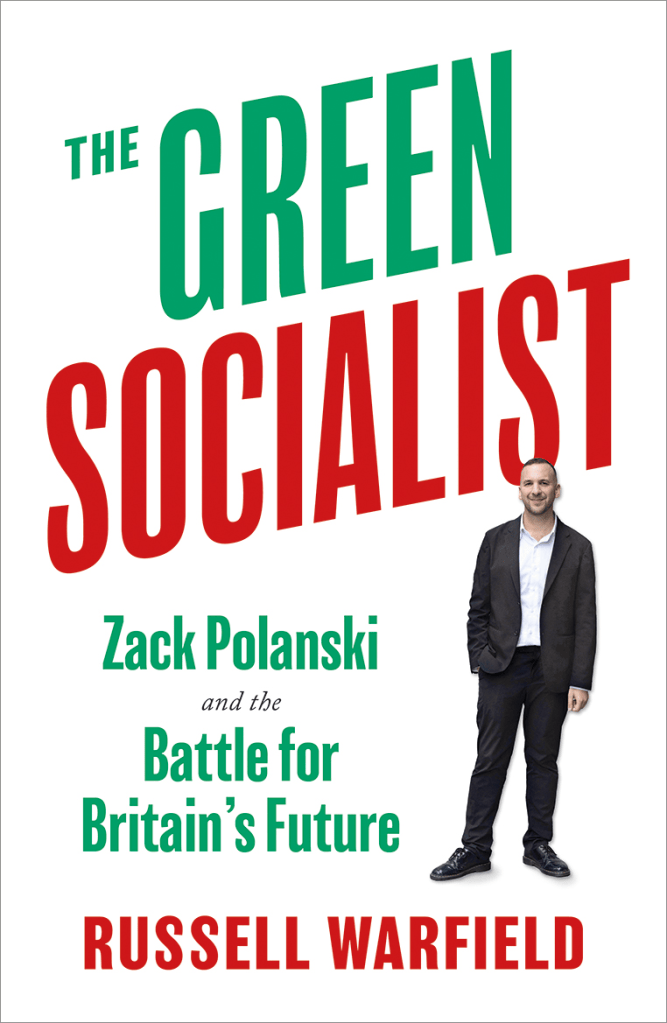
Mike Phipps reviews The Green Socialist: Zack Polanski and the Battle for Britain’s Future, by Russell Warfield, published by Pluto.
To understand the meteoric rise of the Green Party under Zack Polanski, you need to go back a decade or more. Britian faced a crisis of political legitimacy that resulted from the continued neoliberal consensus among the political elite, even as the country was falling apart in the wake of the Great Recession. Jeremy Corbyn capitalised on this mood in 2015 and the next couple of years saw a phenomenal growth in Labour’s membership and its leader’s popularity.
The hopes attached to that project were dashed in 2019, but initiatives like Mick Lynch’s Enough is Enough showed a continued appetite for a radical challenge to the governing mindset. Zack Polanski’s landslide win in the Greens’ 2025 leadership election gave this yearning a clear political focus. As the author explains, “His first year of leadership transcended the wildest expectations of his supporters: quadrupling the party membership, doubling its polling, winning its first ever parliamentary by-election to return a fifth MP, and delivering the Greens’ strongest ever set of local election results.”
Russell Warfield sees Polanski’s platform as eco-socialist. It’s also populist, as a means of overcoming the divisions sown by the far right, while competing with them on shared terrain: a belief that the mainstream political elite are all useless. The peril of this approach, of course, is that if you claim to speak for and represent the interests of the 99%, why aren’t they voting for you?
Potential tensions
To be fair, many are – more than ever before. But can the Greens keep winning everywhere? asks Warfield in Chapter Six. He frames the problem in terms of the potential tension, long experienced by the Lib Dems, that arises from appealing to both urban and rural voters.
In fact, May 2026’s local election results suggested this might not be so big a problem. More concerning, however, given the Greens’ success in a number of boroughs in London especially, could be the party’s radical internationalist positions that are hogging the headlines, making it difficult for local activists to get a hearing for their more prosaic bread-and-butter achievements. Whether the party’s wide range of positions on local, national and international questions affects its target demographics may be too early to tell.
Warfield also asks whether there is a conflict between the Greens’ electoralism and wider organising. That feels like a false dichotomy, easily brushed aside. As the author concedes, “Professor of cultural and political theory Jeremy Gilbert has long made the persuasive case that there is no prospect of a leftwing regime enacting a radical anti-capitalist programme in government if it were not supported and defended by an outright majority of the population.”
Zack Polanski himself appears to get this: “I’ve always been sceptical about community organising being entirely within the Green Party brand, because I think you get to a point where you organise, you get people elected, and then the organising stops.” A bigger worry, however, might be the friction between the party’s electoral hopes and its quest for programmatic purity.
A flying start
Polanski himself is a fairly recent recruit to the Greens, joining only in 2017 after a stint with the Liberal Democrats, preceded by a range of colourful jobs that showcased his communication skills. And there is no doubting his ability as a great communicator. His leadership was also boosted by the failings of that other great hope of the insurgent left, Jeremy Corbyn’s Your Party, which has descended into probably terminal internal turmoil. As a result, a number of high-profile figures, notably former North of Tyne Mayor Jamie Driscoll, have joined Polanski’s movement. The Gorton and Denton by-election win, recounted in detail here, underlined the electoral popularity of the project as well.
But after this flying start, Polanski has some longer-term problems to deal with. He is less popular within his party among the older members who date back to the 1980s and 1990s – a minority now, given the surge in membership. But they remain important because this layer established the party’s programme-heavy and hyper-democratic internal culture that values ideological clarity over media soundbites and vulgar vote-winning.
Warfield reckons “the potential for a politics like Polanski’s has been encoded into the DNA of the party from its inception.” Programmatically, that may be true. Culturally, it’s not so clear, especially given Polanski’s tendency to talk less about the environment than many Greens traditionally.
Culture, strategy and tactics
The bigger worry for the Greens is whether its development as a mass electoral party is compatible with an internal culture where a relatively small number of activists make policy and decide organisational matters for a traditionally passive wider membership. As the party becomes both more radical and closer to power at local level, this is raising some significant difficulties, for example, when a motion at the 2025 Green conference, conceived by a Brighton barista and entitled “Abolish landlords” made hostile national headlines. The author excuses Polanski, saying he had “almost nothing to do with it,” but this might be part of the problem in an organisation where any member can turn up at the conference and vote. A similar problem surfaced this year with the “Zionism is racism” motion.
Secondly, strategy. When Polanski won the leadership, his victory speech contained a pledge to replace Labour. He explicitly ruled out any sort of national level coordination with Labour under Keir Starmer. This chimed with the views of many on the left that Starmer had irrevocably taken the Labour Party across the line from social democracy to something pretty indistinguishable from conservatism.
Today, with Andy Burnham installed as leader, that analysis looks mistaken. Many are saying his recent speeches are the most left wing a Labour Prime minster has made since Harold Wilson or before. Politics can take strange turns, but the self-preservation instincts of the large institutional parties, especially Labour, rooted in the trade unions and the broader movement, should not be underestimated.
Polanski can credibly take some credit for Starmer’s downfall and Labour’s shift, at least in rhetoric, to the left. It was a reasonable pitch in the Holborn and St Pancras by-election to say voters should back him to keep the pressure on Labour’s new leader. But it would be less realistic now to talk in terms of replacing Labour, particularly as that perspective implies an effective intervention in the key affiliated unions to align them with the Green Party. That always looked like a long-term aspiration, but right now it seems far-fetched.
A more collaborative approach may be needed: if the main thing progressives fear is a hard right government of one kind or another, the Green leadership will now have to do some serious reflection on how it orients to Andy Burnham’s Labour Party nationally and locally to prevent that.
Lastly, tactics. Without getting into the rights and wrongs of the motion on Zionism at the 2026 Green Party conference, its passage guaranteed that nothing else decided there would be covered by most of the national media. “Days out from a by-election, every headline is about the Greens and antisemitism and you’ve chosen to take it there… At worst it’s going to alienate those who are hovering between voting Labour and voting Green and that’s’ exactly who Zack Polanski is going for,” Ash Sarkar lamented on Novara Media.
Polanski supported amendments to the controversial motion, which were voted down. He then disappeared from the conference to campaign in the Holborn and St Pancras by-election. Given the potential damage to how the party would now be perceived, that looks like an abdication of leadership.
A week is a long time in politics, Harold Wilson famously said. Zack Polanski has said he will not try to change the Green Party policy on Zionism for two years, which could be a political eternity. Many members will feel proud that their leader has stood by the party’s internal policymaking processes, however flawed these may be for an organisation that has grown so quickly. Others see this as a turning point, a critical test of Polanski’s judgment.
Time will tell if his gamble to stick with his party’s processes and policy will pay off. At the moment, the Greens are the subject of a massive political bombardment and need to be defended against malicious accusations. The Palestine Solidarity Campaign has rightly extended “its solidarity to the Green Party of England and Wales and its members who are facing a barrage of media smears and abuse.”
But in a veiled criticism of part of the controversial conference motion which committed the party to a particular outcome of the Israel-Palestine conflict, it added: “Our longstanding policy, shaped in dialogue with our Palestinian partners, is that it is for the Palestinian people as a whole, rather than the solidarity movement in Britain, to decide what form Palestinian self-determination should take.”
The future
“The greatest test of Polanski’s leadership to date came with the elections of May 2026,” writes Warfield in his conclusion. No longer: sadly, his book has been overtaken by events, first with the change of Labour leader and then with the crisis over the conference motion on Zionism and Polanski’s defeat in the Holborn and St Pancras by-election.
One subsequent poll suggested that Polanski’s approval ratings had hit a record low of minus 36 and he now has the lowest popularity of any national leader. Members are openly calling for him to quit and while this looks unlikely in the short term, unsuccessful attempts at future by-elections to become an MP will surely pile pressure on him. Labour’s current change of fortunes show what a difference a new leader can make. It is legitimate to wonder to what extent the Greens’ radicalism and meteoric membership growth could survive in a post-Zack party.
Mike Phipps’ book Don’t Stop Thinking About Tomorrow: The Labour Party after Jeremy Corbyn (OR Books, 2022) can be ordered here.

