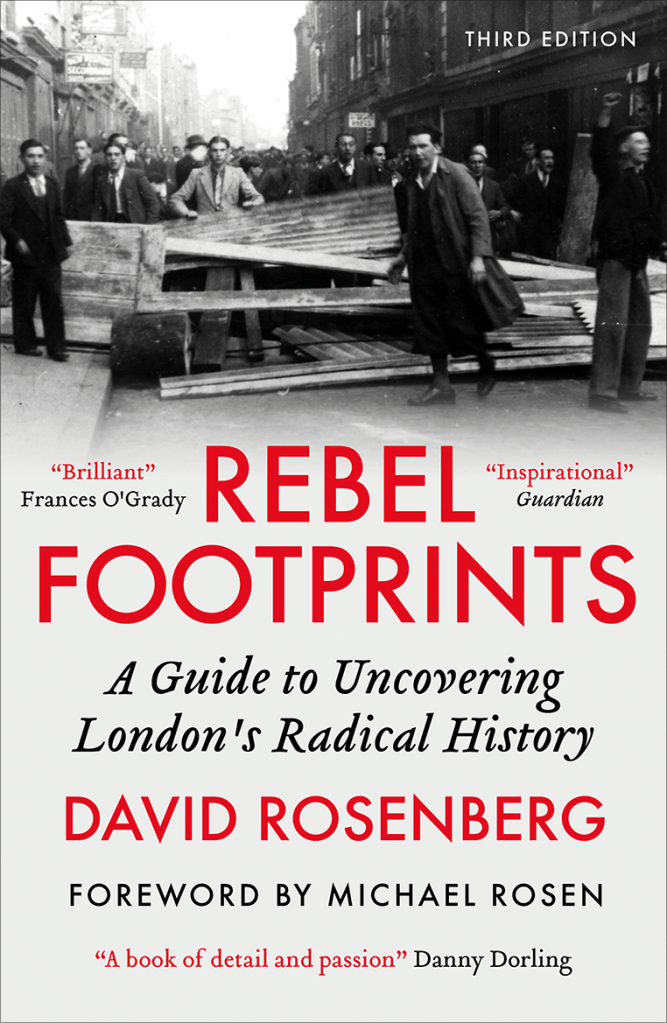
David Rosenberg introduces the third edition of his book Rebel Footprints.
More than 50 people gathered in Marx Memorial Library in early September 2026 for the launch of the new (third) edition of Rebel Footprints: a guide to uncovering London’s radical history, published by Pluto Press. For me It was a return to an old stomping ground. The first edition had been launched there in March 2015. Among the guest speakers I invited back then was my MP, a left wing backbencher and great enthusiast for radical history, Jeremy Corbyn.
The timing of my book was very fortuitous as three months later Corbyn put his hat in the ring in the Labour leadership contest, which heralded one of the most exciting and hopeful periods in Labour’s post-war history. With that came enthusiasm to find out about past radicals, rebels, dreamers and agitators in London, what they did and how they organised themselves to campaign for what they wanted and needed. That enthusiasm heightened when Corbyn became Labour leader with a solid mandate for radical change.
The book grew out of social history walks that I began to create as a personal freelance project from around 2008, having been originally inspired by going on an East End walk by the late Bill Fishman, a lifelong anarchist who taught at Queen Mary University in London’s East End. He firmly believed that you couldn’t simply teach history in a lecture theatre. It was better to walk through it and spark the imagination of students. Having established these with his students, he found himself getting booked for all kinds of groups seeking access to that exciting history
My freelance project continues (though it’s temporarily on hold as I recover from knee replacement surgery). It is supplemented by walks-based and other courses on London’s radical history that I teach at the City Lit Adult Education Institute. A prominent editor at Pluto Press came on a couple of my freelance walks and said very enthusiastically: “I think there is a publishing project here!” The rest, as they say, is history.
The second edition, which added two new chapters with annotated walks, was launched in March 2019 in a more spacious venue with its own radical tradition – Conway Hall. By this time, the Corbyn left project was under sustained attack from right across the establishment, for various overlapping reactionary motives. Superficially it may have seemed that issues around Brexit and Palestine and charges of antisemitism were key, though in my view the establishment were terrified that he might actually redistribute wealth and political power. But Corbyn-led Labour were not yet vanquished. New readers welcomed the second edition, and a good number who read the first edition bought this one too.
So to the third edition: I was very pleased to be approached to write this by Pluto Press. The themes remain the same – the fight for a better past as well as better future; revealing and celebrating the ‘ordinary heroes’ who have fought for change, for collective liberation, and treating them as human beings with flaws (although George Lansbury was clearly a saint).
The project has consciously sought to put our radical past in conversation with the more hopeful times when the first edition was published, and with an increasingly frightening present in the mid-2020s, by which time Labour had moved firmly to the right, and further right groups had come in from the fringes to enter the mainstream of British politics.
At the same time, though, resistance is growing again at the grassroots. The Green Party under Polanski’s leadership has tilted leftwards and grown massively, despite losing some members after the recent controversy over the “Zionism is racism” motion. Starmer has gone and been replaced by Burnham who knows he has to be different to his predecessor, and is probably beginning to woo back some who had defected to the Greens.
What is different about this third edition? Four new chapters and four new walks with annotated maps. The time frame has expanded a bit, straying beyond the outbreak of the Second World War in some chapters, into the 1940s and 50s.
The first new chapter is another set in East London, but looking at this district’s intimate and intricate interaction with the Russian Revolution. It focuses mainly on the 1890s-1920s. The second new chapter is located in Hackney, especially Stoke Newington, Dalston and the Hackney side of Newington Green. It draws on stories and events from the 1780s to the late 1940s.
The third new chapter focuses on Soho and Fitzrovia (which used to be called North Soho), as a destination and a place of political activism, education and mutual aid among refugee exiles who settled there, especially from the 1840s-1890s. The final new chapter which I’ve called “Epilogue” significantly breaks even the new time frame. It focuses on Brick Lane and the surrounding area in the tumultuous 1970s, but is very strongly linked by theme and micro-geography with other struggles recorded in the book.
I had already created some new walks in recent years that I have adapted for some of the new chapters. The Soho one, though, was for me an almost entirely new area of research.
Adding four new chapters is a lot of words! So my publishers instructed me to cut back on the existing words so the book would be roughly the same size as previous editions. That’s not as simple as it sounds. I sewed some chapters together and cut them back so that four chapters became two, but I hope as readers you will find that this new version combines greater coverage with a smoother text.
So far it has been well received. Last week I did a launch event at the Owl Bookshop in Kentish Town, with former Labour MP Emma Dent Coad interviewing me about the book. I read extracts from the new chapters and did a Q&A with the audience. I have other dates for book launch events at Bookmarks in Bloomsbury on Friday 13th November with Michael Rosen (who write the Foreword to this edition) quizzing me about it, and on 21st November I will be doing an event at Housman’s. More events are likely after Christmas – speaking of which in previous years the earlier versions have been very welcome Chanukah or Christmas presents!
Rebel Footprints: a Guide to Uncovering London’s Radical History, by David Rosenberg, Foreword by Michael Rosen, is published by Pluto Press.