
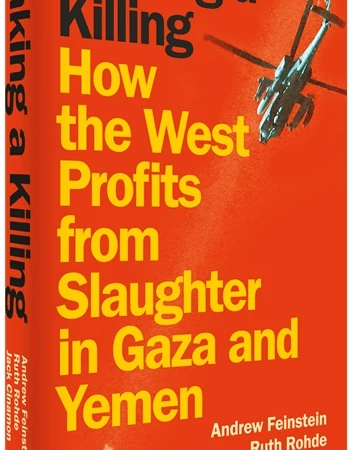
Jack Cinamon and Andrew Feinstein introduce some of the key ideas in their new book Making a Killing: How the West Profits From Slaughter in Gaza and Yemen, published by Verso.
Earlier this week, Ed Miliband announced UK sanctions of various companies involved in building or developing Israeli settlements in the occupied West Bank. Yet, all eight of those sanctioned are Israeli-registered construction companies. There is no mention of UK or other Western companies being sanctioned and no mention of any companies complicit in the total destruction of Gaza over the last three years.
Several major international organisations, UN bodies, human-rights groups and genocide experts have explicitly described Israel’s actions in Gaza as genocide. It would not have been able to continue if it was not for the aiding, abetting and frankly, participation of our government and its allies.
And the same pattern follows for the war on Yemen, often labelled ‘the forgotten war’, in which the Saudi/UAE-led coalition has caused a huge amount of suffering, violated international humanitarian law and likely committed war crimes. This forgotten conflict has recently reignited with Britain immediately promising weapons and personnel support to Saudi Arabia.
In our latest book, Making a Killing: How the West Profits from Slaughter in Gaza and Yemen, we untangle the complex web of who exactly profits from the violence in these two countries. Of course, this includes the traditional players: the arms companies (the most well-known in the UK is BAE Systems) and their CEOs, the politicians, the sales executives and the middlemen.
But it also exposes more clandestine culprits, including the lobbyists, the think tanks, the logistics firms, the asset managers and more. In the book, we uncover the shady deals behind the arms trade and the impact of these decisions in the halls of Westminster, Washington D.C., Berlin and more. The book reveals not simply a relationship between a weapons manufacturer and a government. It lays bare an entire ecosystem of profiteering.
Through a very conservative calculation, we expose that Western countries sold Saudi Arabia more than $106 billion and the UAE more than $23 billion of weapons between 2015 and 2022 – the most intense period of the War on Yemen. The same countries sold more than $50 billion worth of weapons to Israel from October 2023 until the ‘ceasefire’ in 2025.
The UK and its associated arms companies, continued selling Israel weapons throughout the genocide, despite Labour’s insistence that it suspended several arms licences.
Yet, none of these companies have been held accountable. It’s very easy for the UK government to now point fingers at Israeli construction companies in the West Bank, while avoiding at all costs the situation of their and UK companies’ own complicity in Gaza.
Between 2015 and 2022, BAE Systems, the UK’s largest arms company, made over £22 billion in revenue from deals with Saudi Arabia alone. While 15% of every F-35 fighter jet used to bombard a defenceless population in Gaza is made by the company.
Spanning the two conflicts, BAE’s CEO’s Charles Woodburn and his predecessor Ian King raked in at least £76 million personally.
The book, Making a Killing, is about who profits, who pays, and who should be held accountable. It delves deep into the supply chain feeding the wars, and analyses the damage that this gross profiteering causes to our own democracies at home. Through lobbying and political influence, arms companies are able to shape government policy.
This malignant influence is only strengthened through the revolving door, the movement of key individuals between government, arms companies, the lobbyists and the military, often for significant money. This creates profound questions of conflicts of interests, undermining policy processes and fiscal allocations. It also creates political class that has to silence or suppress those who challenge that agenda.
This includes people who oppose increased militarisation or express solidarity with Palestinians. Thousands of people have been arrested and labelled as terrorists for holding placards opposing genocide, while other routes to resistance have also been heavily suppressed.
As highlighted throughout the book, arms deals are amongst the most effective mechanism for converting public money into private profits. And the consequences of this model are felt twice-over: by hundreds of thousands of civilians in Palestine and Yemen, who pay the ultimate price; but also by working people in Britain, who are forced to accept permanent austerity while private companies and their overpaid executives rake in the profits of public spending. So taxpayers funding this boondoggle experience an ongoing cost of living crisis, better termed a ‘profiteering crisis’, where cuts to welfare run deeper and deeper.
Instead of prioritising human security – the environment, defences against global pandemics, well-functioning public services – we have hyper-militarisation, leading to further profiteering amidst ever more alarmist rhetoric around the need for national security and ever greater military spending.
Although occasional actions by the Labour government, such as the recognition of a Palestinian state, are to be welcomed, they are far too little far too late – especially as the government continues to provide weapons and political cover for Israel’s ongoing atrocities. The suspension of a small portion of arms licences while continuing others, especially the F35 provisioning, is unacceptable. The only rational, legal and moral position is a two-way arms embargo on Israel until the genocide, apartheid and illegal occupation are consigned to history. Similarly, the continuing untroubled political relationships with the Saudis and Emirates is unacceptable while these countries continue to cause immiseration and suffering in Yemen, the Sudan and elsewhere, while committing ongoing human rights abuses at home.
Making A Killing starts with the victims of Gaza and Yemen. This was done to remind the reader of the devastating human impact of the government’s corrupted decision-making, and to make clear that where a national security elite is profiting from these conflicts, the losses can be calculated in human lives. By following the money and tracing the supply chains, we expose the indefensible reality of this war economy in which the profits generated by violence are distributed across the Western economy, while the human costs are concentrated among the people experiencing daily slaughter and destruction.
As Helen Lackner, author of Yemen in Crisis, puts it: “Most people are shocked by the horrific bombing of civilians in Palestine and Yemen. This book follows how the weapons are made, from the innocent victims back to the producers, dealers and distributors directly implicated in the value chain, as well as the governments complicit in these crimes. It will be invaluable for anyone challenging the arms trade.”
It is a deadly absurdity to sanction those companies involved in the expansion of Israeli settlements while ignoring the very structures and systems that make occupation and military destruction possible. If serious, the government must be prepared to not only scrutinize Israeli construction companies, but also the British arms companies providing the weaponry, our financial institutions investing in companies complicit in human rights abuses, and the logistics firms transporting the weapons of war to be used in the targeting of civilians.
And the government must alter the very political relationships that have made all these networks not only possible, but also very profitable. Otherwise sanctioning simply appears as a convenient way of looking like you’re doing something while avoiding all levels of Britain’s own very real complicity.
Ultimately, in Making a Killing, we reconsider what accountability actually means. It cannot simply begin and end with the condemning of the destruction of Gaza or the humanitarian situation in Yemen. It cannot also be the limited sanctioning of companies while the wider network of Western profiteering and complicity remains untouched.
Simply put, we cannot claim to oppose the violence while continuing to profit from the structures that make it possible.
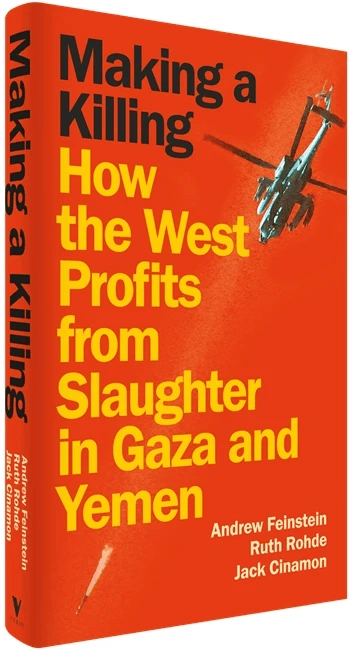
Making a Killing: How the West Profits from Slaughter in Gaza and Yemen, co-authored by Andrew Feinstein, Ruth Rohde, Jack Cinamon with Anna Stavrianakis and Paul Holden is available from Verso on November 24th.
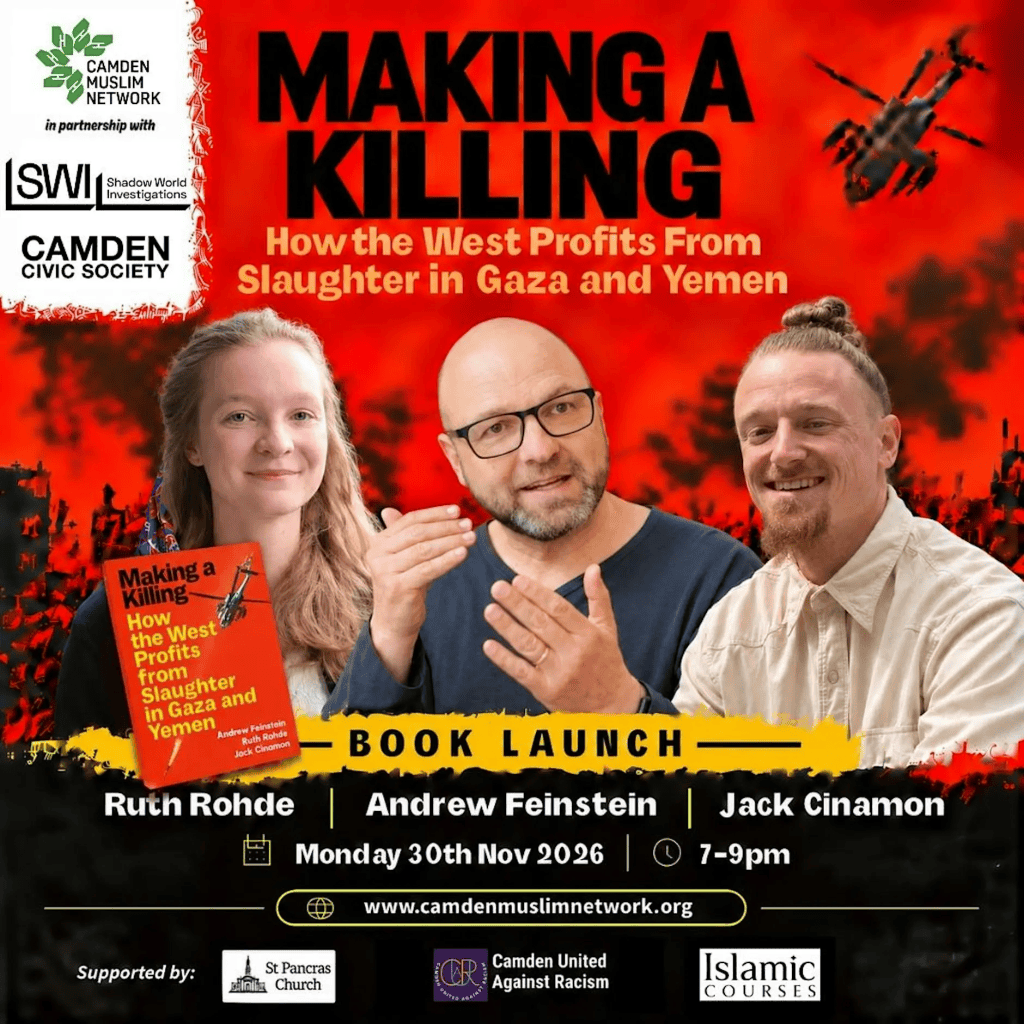
The book will be launched in London on Monday November 30th – register here.
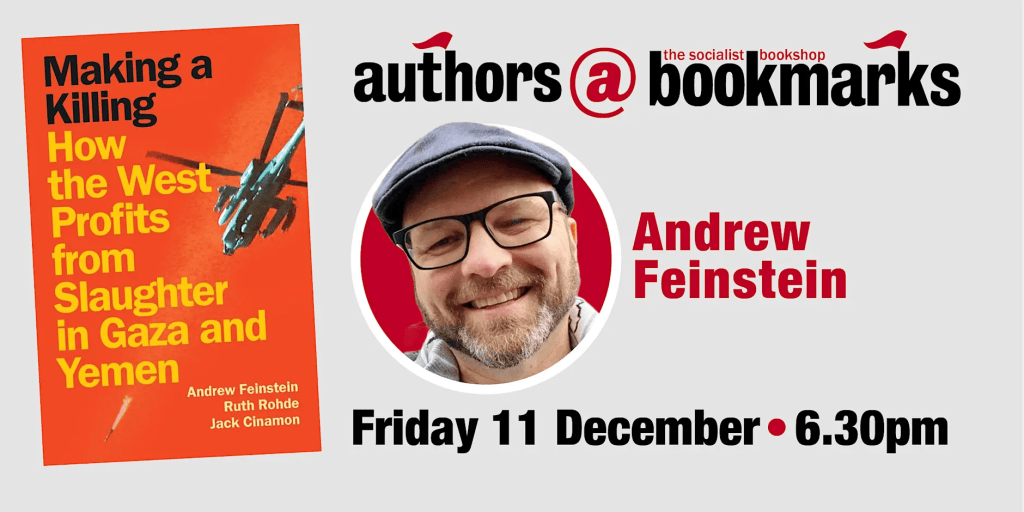
See Andrew Feinstein talk about the new book at Bookmarks bookshop on Friday December 11th – register here.

