
By Campaign Against Arms Trade
In a global order increasingly characterised by rapid militarisation, war and genocide, the UK has long played an important role in the arms trade that fuels it. This government must take a different approach.
Successive governments, both Conservative and, in recent years, that of Keir Starmer’s Labour, have overseen a profoundly permissive arms export licensing system that allows arms exports to continue to repressive regimes and countries engaged in brutal armed conflicts, where this is politically convenient.
Nowhere has this been more explicit than in Gaza.
In September 2024, the government implement a partial suspension on arms exports to Israel on the basis that it was “unable to conclude anything other than” that for certain UK arms exports to Israel there is a clear risk that they might be used to commit or facilitate a serious violation of international humanitarian law (IHL) in Gaza.
Despite this conclusion, the partial suspension gave rise to, among other exemptions, the unprecedented F-35 carve out, which provides for the export of components for the F-35 combat aircraft, used extensively by Israel in violations of IHL.
It also included the maintenance of “incorporation licenses”, covering the export of UK parts to Israeli companies for the purposes of re-export and therefore providing crucial support for the Israeli arms industry, as well export licenses covering categories such as trainer aircraft, naval components and surveillance technologies integral to the Israeli military.
The change in UK government in July 2026 prompted a welcome shift in rhetoric. During his Commons statement on Israel, Foreign Secretary Ed Miliband agreed that ethnic cleansing is being undertaken in the West Bank, and declared the occupation unlawful. At the Labour Party Conference, he told those who had campaigned for Palestinian rights that “we hear you, you were right.”
This rhetorical shift has, however, thus far led to no meaningful change in its arms export policy to Israel. Despite announcing on 8th September 2026 that the government would now “refuse all licence applications for arms and other exports that materially contribute to the occupation”, none of the above mentioned licenses have been suspended.
Pressure must be applied to give meaning to this policy.
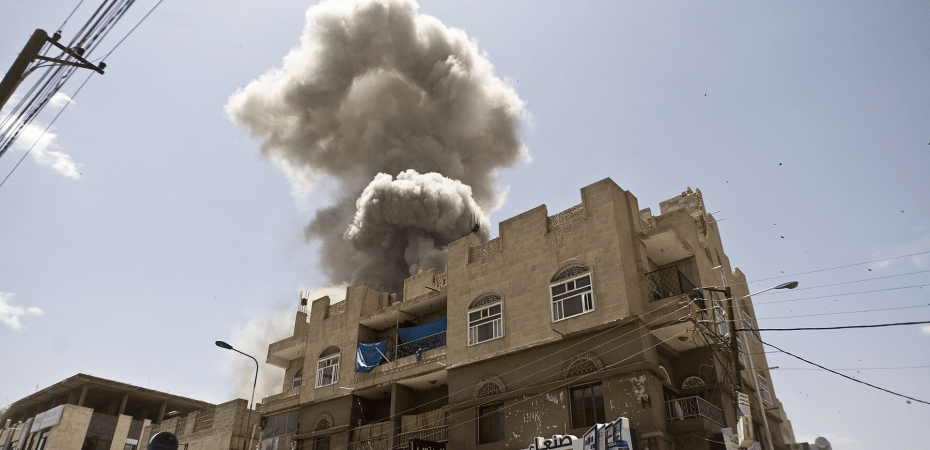
There are also alarming escalations in Saudi Arabia, where on 22nd September, the government announced that it was providing air-to-air refuelling support for “defensive” Saudi bombing operations in Yemen.
The UN has estimated that the war in Yemen, which began in March 2015, had killed 377,000 people by the end of 2021, either directly through armed conflict or the resultant humanitarian crisis. During this period, the Conservative government expressed full-throated support for the Saudi-led war effort, and committed itself to supplying all the munitions, maintenance, support and logistics needed by Saudi Arabia to prosecute the war.
This continued even as evidence of war crimes committed by coalition air strikes mounted, including indiscriminate attacks on populated areas, hospitals, mosques, public gatherings and food, water, energy and transport infrastructure, combined with a crippling blockade of rebel-held areas.
This government must learn from these mistakes and not again become complicit in these crimes.
These are but two alarming situations. Recently, CAAT has published several reports detailing the nature of the UK arms trade today, and how it facilitates war, repression and genocide. These include:
- Reparations for Yemen – a proposal for a windfall tax on British arms companies that enabled Saudi war crimes (with Transition Security Project)
- Dead Letter – How the UK government’s arms export policies have eviscerated international humanitarian law
- Transparent as mud – How UK arms export reporting obscures as much as it reveals
- Entangled – Mapping the UK-US arms trade and their intertwined arms industries, and the dangerous dependencies, warmongering and complicity that result.
CAAT’s annual report on data and trends in the UK arms trade in 2025-26 will be published on 9th December.
To discuss the issues raised in these reports, and the state of the arms trade more broadly in the UK and globally, CAAT is hosting a webinar on Wednesday 9th December, at 18:30.
The speakers will be:
- Sam Perlo-Freeman, CAAT Research Coordinator
- Sara Segneri, International criminal law and human rights lawyer, Continuum Strategies
- David Wearing, Associate Professor of International Relations, University of Sussex
- Jack Cinamon, Researcher and Parliamentary Liaison, Shadow World Investigations
Moderator: Kirsten Bayes, CAAT Outreach Coordinator.
We hope you will be able to join us and be part of this important debate. Please register here.
Image: https://commons.wikimedia.org/wiki/File:Aerial_bombardments_on_Sana%27a,_Yemen_from_Saudi_Arabia_without_the_right_aircraft._injustice_-_panoramio.jpg Source:
https://web.archive.org/web/20161102012223/http://www.panoramio.com/photo/128811239. Author: fahd sadi, licensed under the Creative Commons Attribution 3.0 Unported license.


