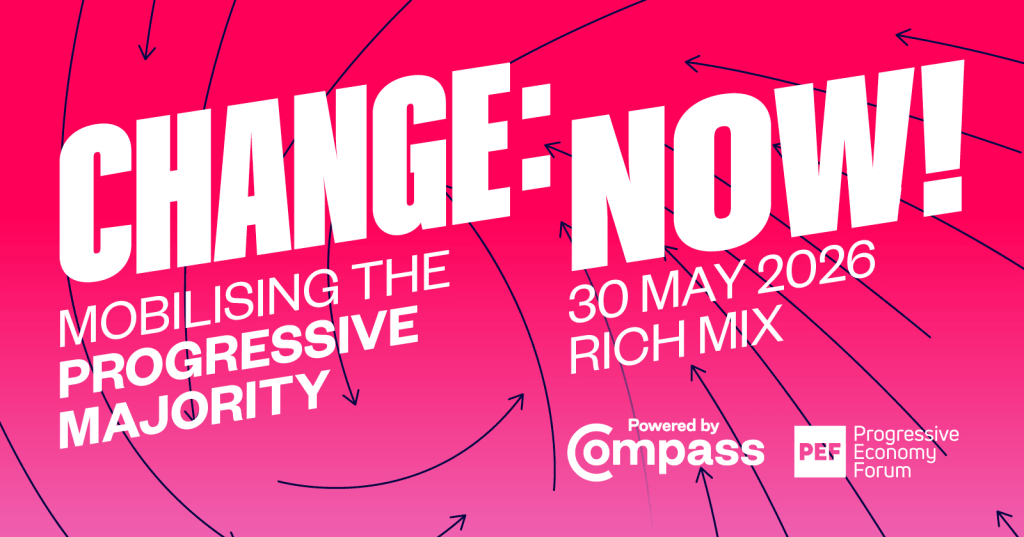
Ahead of the upcoming Compass conference on May 30th, Stewart Lansley has written a new pamphlet, “Steering the ship: How Britain lost the power to progress and how to get it back.”
“Britain is both an immensely rich and immensely poor country,” argues Stewart Lansley, visiting fellow at the University of Bristol, in this new pamphlet, which will be published for the Progressive Economy Forum / Compass conference on 30th May. “Personal fortunes have reached new heights, while levels of poverty are close to record levels. After two decades of feeble growth, the nation has fallen to 28th place across the world in national output per person.”
Lansley identifies three interconnected structural faults that lie at the roots of Britain’s increasingly broken economy and fragile society: the growth of unproductive and pro-rich forms of wealth accumulation, a return towards wealth and income concentrations of the past, and a shift from democratic and social control over the economy to elite and unaccountable financial institutions and individuals. “Together these forces have brought both an economic slowdown and widened the gap between economic activity and high social value.”
Recent surges in wealth holding have been accompanied by falling rates of investment, productivity and growth. A ‘wealth grab’ is taking place but it’s not benefiting society as a whole. Financial markets have separated from social useful accumulation. One study estimated that the cost to the UK economy of ‘too much finance’ over the 20 years from 1995 to 2015 adds up to some £4,500 billion in terms of lost growth.
Scarce resources are diverted away from what is socially useful to the luxury goods market available only to the super-rich. “Britain hosts vast and lucrative industries, from tax avoidance to lobbying and public relations, that usurp resources for the sole purpose of protecting and building personal fortunes and buying economic power.”
The dismantling of constraints over the workings of finance capital in particular has not only weakened states’ capacity to control the economy. It has also made states poorer, “lowering their capacity to handle issues like inequality, poverty, social reconstruction, climate change, the Covid crisis and the growing costs of pension provision.”
Can government fix this? Bad government has certainly made it worse. A decade of austerity has ravaged the health sector and decimated local council funding, hitting youth facilities, road maintenance, libraries, play areas and parks – and closing 1,500 Sure Start Centres for children in England. While the Treasury imposed a financial straitjacket, the Bank of England’s quantitative easing programme fuelled speculative activity, the takeover boom spiralling and property and share prices.
The challenge, argues Lansley, is to develop a “more restrained model of capitalism aimed at breaking up today’s great concentrations of wealth and control, and locking in higher social value activity. This requires greater social control of the economy through the restoration of democratic and accountable institutions.”
Measures should include tougher regulations on anti-competitive behaviour, including takeover activity and foreign ownership. New rules are needed on the scale of leveraged borrowing, and on private equity, including restrictions on profiteering in areas like social care and children’s services.
A more progressive tax system will be essential. Key services – from water, energy and public transport, to a range of vital social services – should be collectively provided and publicly accountable. A collectively-owned Citizen’s Wealth Fund with explicit social goals aimed at giving all citizens a direct stake in the economy should be created.
Whether such measures would spook the dreaded bond markets is not clear. Perhaps that is why Eric Shaw, in a recent Compass pamphlet reviewed on this site, wrote of “the need for extra-parliamentary forces to be mobilised” in support of such a programme. A government committed to implanting such measures would be a very good start.
Change: NOW! Mobilising the Progressive Majority, a conference organised by Compass, will be held on Saturday May 30th at Rich Mix, 35-47 Bethnal Green Road, E1 6LA. More information here.