
Guy Standing reflects on who is deserting Labour, where their votes are going and whether the Party is rescuable.
The precariat has just spoken, and the commentariat did not notice. The precariat is today’s mass ‘working class’, defined in three dimensions – distinctive relations of production, distinctive relations of distribution and distinctive relations to the state. Failing to understand its character as a ‘dangerous class’ is at the heart of the failure of all centre-left political parties to mobilise support from it. The precariat is ‘dangerous’ because it does not support old orthodox political norms.
Very briefly, consider the three dimensions that make the precariat a class. First, but not most importantly, those in the precariat have to endure unstable, insecure labour, and do a lot of unpaid labour and work-for-labour off workplaces and outside designated labour time. They also lack an occupational or organisational narrative to give to their lives. It is also the first working class in history that as a norm has a level of schooling above what is really required for the type of job they can obtain.
Second, they have to rely almost solely on money wages, which are low, stagnant, volatile and uncertain. They typically lack non-wage benefits and entitlements, quite unlike the old proletariat. They are also systematically exploited by debt. Least appreciated, their living standards have been eroded by loss of all forms of commons, including free libraries, free parks, allotments, free or subsidised legal institutions, and free or subsidised education.
Third, this is the first mass class that is systematically losing the rights of citizenship, or what the French call les droits acquis. This is the essence of precarity, which stems from the Latin to mean ‘to obtain by prayer’. This is the most important factor. The precariat feels like supplicants, relying on discretionary decisions from figures in positions of authority, be they landlords, employers, bureaucrats, parents or ‘colleagues’.
None of these three dimensions correspond to the journalistic notion of ‘left behind’. But a crucial point is that the precariat has been a class-in-the-making, not yet a class-for-itself. What this means, put crudely, is that those in it are more united about a politics of grievance, centred on chronic insecurity, than about a preferred politics of hope. This is changing, partly because many more people are in or near being in the precariat, and more do not feel ashamed about that, recognising that there are structural causes of their shared insecurity.
However, the precariat still consists of three factions, which I call Atavists, Nostalgics and Progressives. It is how these three factions reacted on May 7th that made it the First Precariat Election. They shaped its outcome.
The Atavists – basically, the relatively uneducated who have entered the precariat by falling out of old working class households or communities – deserted Labour decisively and voted for Reform, the populist right. By contrast, the Nostalgics – basically, migrants and racial minorities, who yearn for a home, for a present – deserted Labour and voted Green, or for some independent candidate or just did not vote. And perhaps most revealingly, the Progressives – basically, the young, relatively educated – deserted Labour in droves and largely voted Green
In each case, there should be two questions. Why did they desert Labour? And why did they vote for a specific alternative? The answers to both questions are actually pretty clear. And they do not offer Labour much hope of recovery before the next General Election, given Labour’s history and the road of ‘change’ on which the current leadership is embarked. The suggestion should be that, contrary to Wes Streeting’s claim in his resignation letter, Starmer and Reeves have had a vision and a strategy, but both are such as to be unappealing to the British electorate, particularly to all factions of the precariat.
That was flagged very clearly in Rachel Reeves’ Mais Lecture of March 2024, entitled ‘Economic Growth in an Age of Insecurity’, as she prepared to become Chancellor of the Exchequer. In spite of its signature word ‘securonomics’, drawing on the ill-fated ‘Bidenomics’, it was a Lecture that any senior Treasury or Bank of England official would have liked to make. The vision and strategy was to entice American finance and direct investment to boost GDP growth, from which British living standards would, it was presumed, rise, for everybody. Securonomics was ‘modern supply side economics’, and the same strategy was reiterated in Reeves’ Mais Lecture of March 2026, and underpins the well-advertised deregulatory moves made since 2024.
Reeves used the word ‘security’ 17 times in that first Mais Lecture. But on every occasion it was about guaranteeing security for capital, and particularly American capital. Not once did she mention the economic security of British people, let alone the precariat. And herein lies the main answer to why droves of people in and around the precariat deserted Labour, or were not drawn to it, on May 7th.
The main reason the precariat has deserted Labour is that they have not been offered any reduction in chronic economic insecurity. In many of the resignation letters from MPs since the May 7th elections, Starmer was praised for ‘making the Labour Party electable again’. This is delusionary. In 2024, the Party received fewer votes than under Jeremy Corbyn in 2019, when it lost heavily – 34% compared with Corbyn’s 40%. Because of the low turnout, It only received the support of about 20% of the electorate, and only achieved a landslide victory because the Conservatives were exhausted and fragmenting. The fact is Labour has made no attempt to offer the precariat any relief from chronic insecurity.
Nothing in Labour’s manifesto or actions since its election have been aimed at alleviating the precariat’s multiple forms of economic insecurity. Indeed, in its eagerness to appeal to American financiers, not only has Reeves actively sought their approval before her Budgets, but the government has made the insecurity of large parts of the precariat worse in order to limit tax increases on financial capital. Indeed, and one heard it again immediately after the local elections in May, there has been talk of ‘welfare reform’, code for cutting state benefits and making them harder to obtain and to maintain. Lord Jim O’Neill, former Goldman Sachs Chief Economist and Conservative minister, was at that again on Sky TV on May 13th.
The fact is that already spending on benefits is among the lowest in the OECD, as the National Institute of Economic and Social Research showed last year. And the Labour leadership shows no sign of wanting to alter the mean-spirited means-testing and behaviour-testing underlying the system. Does anybody in Labour expect this government to overhaul the odious punitive Universal Credit system? Does anybody believe that the reform of disability benefits is about improving the economic and social security of the millions of people with disabilities, rather than just reducing costs?
The answer to the second question – about why those who deserted Labour voted as they did – is more nuanced. In past elections, there were no clear options for the disaffected precariat, so many grudgingly voted Labour or stayed at home. But this election was the first in which there were parties making clear appeals to the new mass class.
The Atavistic part of the precariat deserted Labour decisively and voted for Reform, whose basic message is that their insecurities are due to migrants and certain racial and religious minorities, carefully diverting the blame from the plutocracy. Labour’s leadership could not respond effectively because its vision-and-strategy depended on appealing to the plutocracy to invest more in Britain.
Indeed, Starmer had contributed to it with his ‘island of strangers’ speech, echoing Enoch Powell’s notorious ‘rivers of blood’ speech of 1968. In trying to prevent the drift to Reform, somebody had to be blamed for the continuing insecurity among the precariat. So the government let loose Shabana Mahmood, the Home Secretary, ironically a devout Muslim, whose anti-migrant rhetoric and actions have compounded the distaste for Labour in the other two factions of the precariat.
Meanwhile, the Nostalgics – migrants and racial minorities – had cause enough to desert Labour due to their acute insecurities, which Mahmood intensified. They were also alienated by the Labour government’s complicity in Israel’s genocidal actions in Gaza and the occupied West Bank, which was undeniable. Starmer’s immediate reaction to October 7th 2023 was to say that collective punishment through denial of food, water and medicine was justified. As the visible genocide unfolded, the government continued to allow the sale of 250 types of weapon to Israel and the use of British intelligence gathering. Its stance was made worse by proscribing the protest group Palestine Action as a ‘terrorist’ group, without giving any evidence that this was correct.
So, it was not difficult to explain why the Nostalgics deserted Labour. However, they were not drawn to Reform. Some no doubt turned to the Greens or Liberal Democrats or Scottish or Welsh nationalists. But equally no doubt many simply felt disenfranchised, and therefore did not vote at all. Either way, Labour has probably lost the Nostalgics for the foreseeable future, given that whoever takes over there will still be leading figures in the Cabinet who have been responsible for the decisions on Gaza, refugees and the persistence of existential insecurity among migrant precariat communities.
This leaves the Progressive faction, consisting of the rapidly growing number of young relatively educated entrants into the precariat. Their predecessors tended to give Labour the benefit of the doubt, voting for it in order to rid the country of the Conservatives, and before that being drawn to Jeremy Corbyn and John McDonnell.
But they have deserted this Labour government in droves, because it has not offered any sense of a different more secure future, because it has not shown any appreciation of the depth of crisis of the education system, because of Gaza, and because it is curbing the freedom to protest. Above all, this election was the first time there was a robust populist party offering an alternative vision, the Greens. Remarkably, on May 7th more young educated people voted for the Greens than for any other party.
Would a change of leadership restore Labour’s fortunes? In the coming months of dialogue within the Party, an existential question should be hovering in the background. Is Labour rescuable? Changing the vision and strategy would take considerable time. The bond market would constrain any rapid change. At this moment, great hope is being placed on Andy Burnham. But even if he were to take over late in 2026, he would not have a mandate to take transformative action to aid all three factions of the precariat.
All those who consider themselves progressive must remember that all great ‘forward marches’ are led by the interests, needs and aspirations of the emerging mass class. If Burnham does take over, his best tactic would be to announce immediately some form of electoral reform towards proportional representation, which he is known to support. That might give the bond markets the jitters, but possibly not do so because electoral reform would reduce the likelihood of an extreme populist winning power.
Similarly, Burnham is known to support a basic income, which would reduce economic insecurity and appeal to many in the precariat. Proposing to move too fast would cause bond market jitters, but the spreading fear of job-destroying Artificial Intelligence could overcome those, especially as many of the plutocrats in Wall Street and Silicon Valley have come round to saying it will be essential to prevent destabilising political extremism.
Whoever takes over as Prime Minister should set up a series of national – Royal, if necessary – commissions. One should consider how economic growth could be recalibrated, to escape the distortions of GDP. Another should consider how the blatantly dysfunctional education system could be rescued. Another should focus on ways of reducing the extreme financialisation of all parts of the British economy. Another should focus on ways of rescuing fiscal policy, including reducing the enormous range of regressive subsidies.
None of this should frighten the bond markets excessively. They would give Labour time to decide whether the Party is over or whether it can be regenerated to appeal to the precariat.
Guy Standing’s new book, Human Capital: The Tragedy of the Education Commons, reviewed here on Labour Hub, was published by Pelican in January 2026.Guy will be elaborating on the above analysis in his speech at the Compass-Progressive Economic Forum Conference ‘Change Now: Mobilising the Progressive Majority’, at Rich Mix, London, on May 30th. More information here.
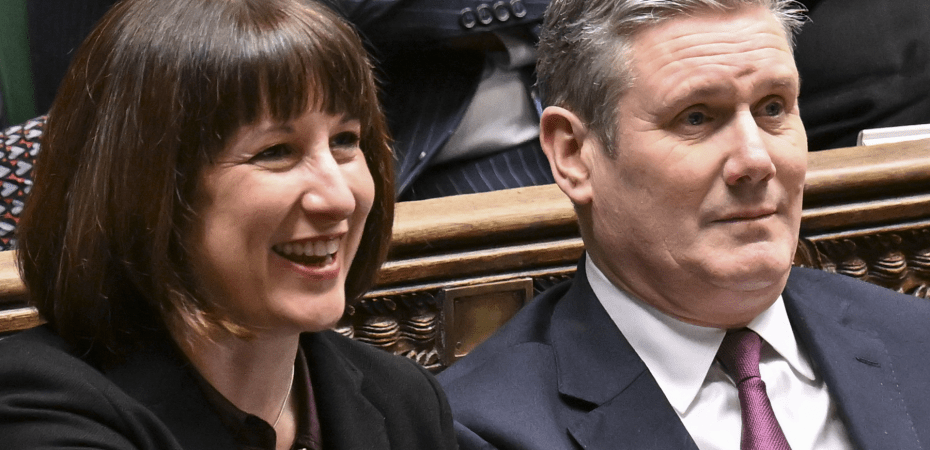
Image: https://commons.wikimedia.org/wiki/File:Rachel_Reeves_and_Keir_Starmer.jpg Rachel Reeves and Keir Starmer Source: UK Parliament Author: © UK Parliament / Maria Unger, licensed under the Creative Commons Attribution 3.0 Unported license.


