
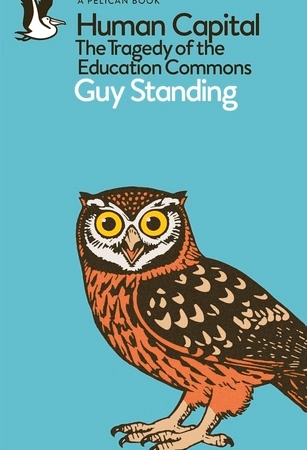
Mike Phipps reviews Human Capital: The Tragedy of the Education Commons, by Guy Standing, published by Pelican.
Fascism doesn’t necessarily begin with violence. It begins with lies. Hanhan Arendt said: “A people that no longer can believe anything cannot make up its mind. And with such a people, you can then do what you please.”
On that basis, discrediting truth-making institutions is the key to taking society and governance in an authoritarian direction. That includes the education system. It’s not accidental that Trump famously said: “I love the poorly educated.”
Nor is it accidental that one of the largest universities in the US has just banned the teaching of Plato’s Symposium to undergraduates. The entire philosophical basis of public education from the Athenian era onwards – the search for truth through dialogue, the equal right to speak and hear, including the right to speak truth to power without retribution – is being challenged by those who have a very different conception of, and purpose for, education.
Inculcating the values of rentier capitalism
The traditional liberal conception of education as a commons-based good, embodied in Britain in the 1963 Robbins Report, is being replaced by a system for inculcating the values of rentier capitalism: competitiveness, productivity and the sanctity of private property. People are being taught what, not how, to think. Schooling may be expanding, but creativity is not. In the UK and US, new schools are being built without playgrounds.
In 2023, nearly half of 14-year olds in England said they disliked school, up from a quarter in 2015. Mental ill-health is mushrooming among young people. Teaching to the test, associated with competitive societies with high rates of inequality, is especially prevalent in Britain and the US.
Universities, particularly in the US, are adapting to the competitive education market by making courses easier. Nearly half of all students don’t read books unless forced to. But this decline merely reflects a broader pattern in society where reading for pleasure – and with it literacy skills – is plummeting. This is music to the ears of politicians pushing simplistic solutions and hostility to experts.
In Britain, the move away from the education commons has accelerated since Thatcher: an increasing standardization of the curriculum, a focus on schools and universities being run like businesses, and a cult of exams – about half of all time in schools is now spent taking tests. This has fuelled a boom in private tutoring, which attests to both the failings of the academy system and the hyper-competitive ethos it fosters.
Sell off, make profits, cut pay
Privatisation has expanded at all levels. Despite its Sure Start children’s centres, New Labour favoured the privatisation of nursery facilities, and that has continued under subsequent governments. By 2023, the private childcare market in the UK was worth £6.7 billion.
State schools have been privatised by stealth, as school funding reached crisis point, often as a result of expensive, government-encouraged PFI contracts. Forced academization took schools away from local authority accountability, with no real improvement in standards or efficiency. By 2019, over 50,000 children in England were in limbo, waiting to be transferred from one failed academy chain school to another. In one year alone, failing trusts were bailed out with £21 million of public money. Yet heads of academy trusts are extracting huge sums from the scheme, which has been racked by questionable financial practices.
The impact on pay within the profession is shocking. By 2022-3, 775 heads of school academies or trusts were earning over £150,000. Universities are increasingly run by people with a background in business and expect salaries to match. Teaching staff at all levels, in contrast, are being proletarianized, subject to greater standardization, supervision and surveillance. Between 2011 and 2020, one-third of all newly qualified teachers left the profession, due to falling wages, increasing workloads and declining facilities. By 2022, there were 90,000 supply teachers in British schools, all paid substantially less than regular teachers, but making huge profits for the agencies providing them.
Precariousness is spreading in higher education. Oxford, Britain’s richest university, has 77% of its academic staff on casual contracts. Many middle class tutors can afford to work this way, driving out those who can’t.
The New Labour-introduced fees regime has accelerated the growth of private universities, while giant corporations have moved into the lucrative market of student accommodation. Globally, private universities tend to support conservative, often evangelical, ideologies and staff have been sacked for supposedly breaching the limits of political acceptability.
Alongside privatisation, education has been commodified and standardized. New Labour required universities to pay for management consultants and auditors to define and enforce performance indicators. Education was reduced to the preparation of human capital for the needs od business. More testing and grading flowed from this outlook.
Uk universities now operate in a fiercely competitive market to attract grants and students, spending over £500 million a year on recruitment agents, particularly seeking overseas students paying higher fees. In 2013 just 1% of applicants were offered places that were not conditional on exam results. By 2018, that had risen to 23%.
Knowledge too is being commodified. Public universities are contracted to do research for the corporate sector, sometimes giving an academic veneer via their publications to the propaganda of self-interested industries.
By the end of this decade, the global education market will soar to a spending zone of £8 trillion a year. Asset-stripping by private equity companies is already rife. Special Educational Needs and Disabilities (SEND) is an especially lucrative area, given the growing demand and shortage of places. In February, the leader of the Liberal Democrats accused private equity firms of using vulnerable children as “cash cows” and raking in record profits.
He’s not wrong. In 2024, the National Audit Office found that a private SEN place cost £62,000 a year on average, compared to £24,000 in the state sector, with private operators netting £2 billon in fees from cash-strapped local authorities in 2022-3. This cost to councils of meeting their legal obligations represents an existential threat to the financial stability of local government.
Curriculum control
Corporate control also influences the curriculum, for example in the US challenging climate science. It also determines what dissent may be tolerated on campus, as underlined by the recent forcing out of the presidents of Harvard and Pennsylvania Universities for their supposed failure to tackle antisemitism.
These are not isolated examples. Even before Trump, an evangelical religification was spreading through US schools. Trump’s 2025 announcement that he would cut federal funding to any university allowing “illegal protests” was life-threatening to US higher education. When he cancelled $400 million in federal grants and contracts with Columbia, the university capitulated to all his demands, including hiring security teams with arrest powers. More widely, scientific research is being defunded, particularly on climate change and vaccines.
This book is hugely impressive in its detail. But it’s also a call to action. Standing observes that “All the great rebellions in British history have been about defending the commons,” about which he has written extensively. With two-thirds of the population going to university by age 30, the vast majority saddled with lifelong debt and no guaranteed prospect of a job to match their hard-earned qualifications, it looks like education may be the next battleground for a fight to reclaim the commons from the privateers.
Mike Phipps’ book Don’t Stop Thinking About Tomorrow: The Labour Party after Jeremy Corbyn (OR Books, 2022) can be ordered here.


[…] Standing’s new book, Human Capital: The Tragedy of the Education Commons, reviewed here on Labour Hub, was published by Pelican in January 2026.Guy will be elaborating on the above […]
[…] on recruitment agents. But for teaching staff, precarious employment is increasingly the norm: even Oxford, Britain’s richest university, has 77% of its academic staff on casual […]