
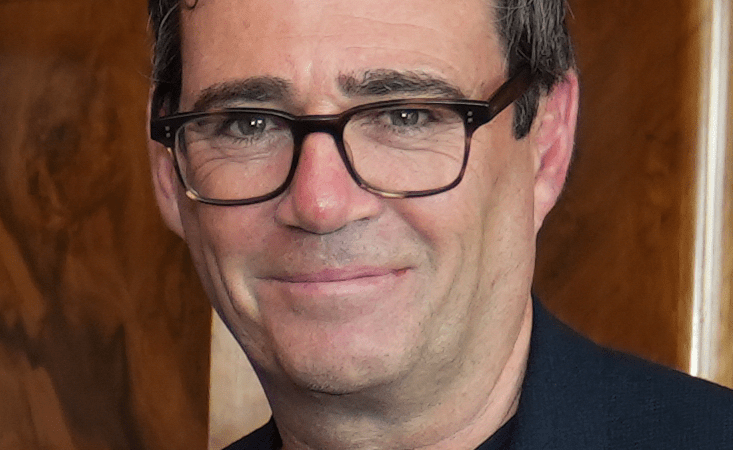
To what extent has his experience as Greater Manchester Mayor prepared Labour’s Makerfield by-election candidate to be a transformative Prime Minister? asks Mike Phipps.
- A life entirely in politics
Andy Burnham joined the Labour Party at 15. A Cambridge graduate, he worked as a researcher for Tessa Jowell MP, a parliamentary officer for the NHS Confederation and an administrator with the Football Task Force for a year. From 1998 to 2001, he was a special adviser to Labour’s Secretary of State for Culture, Media and Sport, before becoming MP for Leigh in Greater Manchester in 2001.
Under Blair, he rose through the ranks before becoming a Cabinet member under Gordon Brown in 2008, reaching the post of Health Secretary. Ambitious, he ran unsuccessfully for the Party leadership in both 2010 and 2015.
Having stood down as an MP to run for Mayor of Greater Manchester in 2017, he is less tainted than many from that era with the campaign to destabilise Jeremy Corbyn’s leadership.
2. How good a Mayor?
Andy Burnham has proved popular enough to win three elections to the office, each time with more than 60% of the vote. He has been much praised for Manchester’s publicly controlled integrated transport network, with capped fares and bus ridership rising 4% year on year.
He was dubbed the ‘King of the North’ after challenging Boris Johnson’s Conservative government during the Covid pandemic, arguing that plans to put Manchester and other parts of the North into a more restrictive lockdown without adequate contingency measures would push people into destitution. His partially successful efforts to secure more funding helped him cultivate a profile as a politician who cares deeply about his patch, a stance he has consistently and publicly reinforced.
Manchester is the fastest-growing place in the UK. “But this growth is very heavily centred on Manchester city centre,” points out urban planning expert Alex Nurse. “Given concerns about who is actually benefiting from high-rise, high-value developments, this might not be something Burnham will shout too loudly about on the streets of Makerfield.”
There have been some noteworthy mis-steps. In 2022, Burnham bowed to political pressure and retreated from plans to introduce a clean air zone in Manchester. And housing campaigners have been disappointed by his giant housing plans, even challenging their legality in court.
“I think almost all of Burnham’s big political interventions round here have been positive,” one local housing expert told me. “But the bedrock of Manchester’s ‘success’ is the same reason some areas of the wider Greater Manchester region are suffering from disproportionately expensive housing. The wider impacts of growth in Greater Manchester pretty conclusively haven’t reached the poorest areas of the borough.”
“That said, his interventions on most things have been very positive,” he continued. He’s been unfairly attacked for the Housing Investment Loans Fund providing finance to big developers like Renaker, but Burnham’s primary intervention has been to redirect the millions of pounds it makes a year in profit into homelessness prevention.”
His overall assessment? “He knows when to pick a fight, and when the fight is right, he’s not scared of it. And has picked fights across party lines without fear or favour. He first clashed with Labour Manchester leader Richard Leese over homelessness, appointing leftwinger Paul Dennett to a senior leadership role in his cabinet and subsequently making him deputy Mayor. He launched the Operation Augusta investigations into several Labour-held Greater Manchester boroughs regarding grooming gangs. He picked a fight with the bus operators over franchising the buses – they were threatening expensive legal action but he took the plunge anyway. He pushed through reform of Greater Manchester Police against the incompetent former Chief Constable Ian Hopkins, and introduced the new and much better Chief Constable Stephen Watson. He fought government over Manchester not receiving London-style business support during tier 3 lockdown. And he’s obviously picked a long-term fight with Keir and the national Labour Party too.
“His big weakness is a lack of grasp of policy. His policy interventions are often quite surface-level and faddy. For example, the homelessness prevention programs he’s established in Greater Manchester are exorbitantly expensive, and don’t at all tackle the root causes of homelessness, above all the lack of social housing. He donates part of his income to a Mayoral Charity, very popular but also ineffective. He shoots from the hip and doesn’t always get it right. He once criticised unpaid contractor labourers who walked off site from roadworks on Regent Road despite the fact they hadn’t been paid for months.”
Another local activist told me that Burnham takes credit for the successes but rarely gets blamed when things go wrong. “Local authorities get loads of stick for failing town centre economies, bad planning decisions, crime, dirt, potholes, low traffic neighbourhoods, etc,” she told me. “But despite the main culprits all now being part of Greater Manchester, it gets little criticism and Andy Burnham is seen as the Bee line bus king, Hillsborough and miners’ compensation champion and general local guy.”
Burnham’s pledge to end rough sleeping in the city by 2020 was not fulfilled. His team were apparently fearful of a possible backlash over the radical Housing First strategy, where street homeless people are given a flat, backed up with personal support to ensure each person, for example, remembers to attend appointments, gets training and so on, in order to retain their tenancy. Instead, the Mayor opted for the less radical No Second Night Out programme, which focuses on funding for hostels and additional supported housing, plus a street homelessness team to find and place people.
3. The ‘journey’
What does Andy Burnham believe in? Currently, the buzzword is ‘Manchesterism’, which Burnham has defined as “the end of neo-liberalism” and “a modern and functional response to the high-inequality, low-growth trap that came from the 1980s drive to privatise economic power and overcentralise political power in the Treasury.” In practice, this may not amount to much more than a re-heated ‘stakeholder capitalism’, a defining feature of the politics of the ‘soft left’ of which Burnham sees himself as a standard-bearer.
Friends of Burnham are keen to point out that the views of Burnham today are very different from those he held in the Blair-Brown governments. Burnham himself has said he was trying to “climb the pole” in his early years in politics and allowed himself to be wrongly packaged in his earlier leadership bids: “I listened to people that I shouldn’t have really… Looking back, for a Labour leadership election, it was tone-deaf. It’s not easy for me to look back at that … it wasn’t me. It wasn’t authentic.”
Neal Lawson, the head of the ‘soft left’ think tank Compass and very close to Burnham, says the latter has genuinely changed since his days in national government. Pivotal to Burnham’s evolution was his experience of championing the campaign for justice for victims of the Hillsborough stadium disaster, who had to wait nearly thirty years for a verdict that the 96 people who died in the Sheffield football stadium in 1989 were unlawfully killed. The degree of establishment obstruction and cover-up, says Lawson, brought home to Burnham how far from a functioning democracy Britian truly was. That’s why constitutional reform – including abolition of the House of Lords and a more proportional electoral system – is central to Burnham’s proposals for change.
Others are more doubtful. Remembering how quickly Keir Starmer torched the ten-point platform on which he ran for the Labour leadership in 2020, they point out that Burnham has, even before his return to Parliament, committed to stick to Chancellor Rachel Reeves’ fiscal rules and Shabana Mahmood’s controversial immigration rule changes, according to his ‘allies’ at least.
But it would be wrong to see no difference between what Burnham is proposing and the current leadership. Burnham has been quite concrete about some of the changes he wants to make and seems genuinely pragmatic. The Starmer leadership seems incapable of breaking from the dominant neoliberal economic model and, as it becomes increasingly beleaguered, seems to be adopting a Macron line: either support us or the far right will take over.
4. Uniquely popular
In one sense, Labour activists’ estimation of Andy Burnham’s politics are secondary to one unavoidable fact: he is popular. Not only that, he is – for Labour – uniquely popular. Part of that is due to his record in Manchester; part is due to his not currently being a Westminster politician, the vast majority of whom are held in unprecedentedly low regard. Other leadership possibles like Ed Miliband or Angela Rayner are liked by the Party membership, but not by the public. Burnham excepted, all Labour potential contenders, including pretty much everyone in the Cabinet, have either negative approval ratings, or are generally unknown.
On that basis, if Labour is to survive in government, it looks like Burnham or nothing. The left may have some influence over the policy agenda, but it will have trouble getting the requisite number of nominations for a credible candidate of its own, thanks to the rigid control of parliamentary selections and the anti-democratic rule changes to internal elections in recent years.
But Burnham’s popularity itself could become a burden. Everyone wants to own a piece of him, to be a shareholder in his stock. Both the left and right in the Party are trying to promote their agendas on the back of his candidacy. The ‘soft left’ are expecting to have more influence over the Labour’s political direction than at any time since Ed Miliband was first elected leader in 2010. The left, on the other hand, has better solutions for tackling the cost of living, climate and public services crises.
5. Can he fix it?
If Andy Burnham were to win his by-election and become Party leader by the autumn, he would have less than three years to turn Labour’s prospects around and ensure a second term. This will require real political delivery on a range of popular policies, not just improved communications, however welcome that might be.
Is it doable? In the opinion of Professor Jeremy Gilbert, one of the UK’s foremost experts on the Labour Party, only Andy Burnham has any idea of the scale of the economic, social and political crises that Britain has ended up in – no other would-be leader comes near. That’s encouraging – but the British political system is not a one-person operation. It’s doubtful that there are many Labour MPs who share his understanding or vision – which attests to the way parliamentary selections have been manipulated in recent years to favour the mediocre – NPCs, as they have been dubbed.
Add to that the fact that Burnham will have to make the calculation, should he become Prime Minister, that every leader has to make: whether it is safer to have the Party’s ‘big beasts’ in the Cabinet as part of the ‘team’, or leave them on the backbenches stirring up disaffection and dividing loyalties. On that basis, a Burnham Cabinet could well include not just Rayner and Miliband, but Streeting and even Starmer himself, already being suggested as a future Foreign Secretary to ensure a smooth transition.
So as Andy Burnham’s transition into Party leader becomes increasingly seen as a foregone conclusion, perhaps the bigger question to be asked is: who’s going to be Home Secretary? Who’s going to be Chancellor of the Exchequer? Health and Education Secretaries? Andy Burnham as leader can only be an improvement, but realistically we should expect some disappointments on the road ahead.
Mike Phipps’ book Don’t Stop Thinking About Tomorrow: The Labour Party after Jeremy Corbyn (OR Books, 2022) can be ordered here.
Image: https://commons.wikimedia.org/wiki/File:Andy_Burnham_on_13_August_2024_%28cropped_2%29.jpg Source: https://www.flickr.com/photos/26320652@N02/53921141434/ Author: Scottish Government, licensed under the Creative Commons Attribution 2.0 Generic license.


