
Ahead of this year’s Orgreave Anniversary March and Rally, Paul Winter recalls the turning point of the 1984-5 miners’ strike.
Orgreave was two thirds of my life ago, but I have to talk about my life before and after to sum it up. I was brought up on a huge council estate near Barnsley. Such was the community in the 1960s and 1970s I can name nearly the entire street.
The kids played and the adults socialised together as a proper community. The boom period was after the strikes my Dad participated in, in 1972 and 1974. The following period brought a car, colour tv, holidays and even my own bed to sleep in, such was the strength of the National Union of Mineworkers.
At ten, how was I to know that revenge would be taken out on me in a field near Sheffield ten years later? By then I’d been three years at the pit and was about to transfer to the Redbrook section of Dodworth Colliery. The government’s own Plan for Coal meant new shafts were sunk and whole new surface infrastructure was built at a cost of millions. Our coal was to be taken out and washed at nearby Woolley Colliery as pits were amalgamated. A central hub in Leicestershire was to oversee the entire industry. We felt safe.
I didn’t go on strike for me. We act as one. The Yorkshire area had agreed to take action if our own were threatened after warning shots in Wales were fired in 1981. The government who were meticulously planning were not ready then and backed off.
So on a personal level I was as happy to go on strike for an unknown comrade in Wales, Scotland or Kent, knowing full well he’d do likewise for me. There was, however, a snag. An incentive bonus scheme had put us on an uneven playing field. A canteen worker on 30% bonus in the Midlands could earn more than a faceworker on 100% in another area. This was as simple as the underground conditions we faced rather than anyone working any harder. When they chose to work in March 1984, the Nottingham miners genuinely thought they were safe and the less productive pits were holding them back (ironically the last pit to close was Kellingley in Yorkshire).
Flying pickets should and would have sorted this. My first few outings to other pits were successful in peacefully picketing other pits out, which meant we were getting the early upper hand. The Ridley Plan was quickly implemented by the government and we were blocked from travelling beyond our county boundaries. This led to my arrest and conviction four days before Orgreave in 1984. This conviction remained on my DBS check records for many years until I put in a freedom of information request… then it vanished in 2015!
Anyway, the failure to get into Nottinghamshire successfully led to a plan of picketing Orgreave coking plant. The unions had agreed to allow enough coal to get to Scunthorpe so the furnaces would not be compromised, but not enough to produce steel. This however was being breached. The NUM made it plain we were going to Orgreave en bloc on Monday 18th June.
Despite wall to wall media coverage of the strike, no one said we couldn’t go. Because my earlier arrest left me with bail conditions, I didn’t go with my own branch. No roadblocks, no one stopped us, we were led to the field by the largest amount of police I’ve seen in my life. They had helmets, long batons, riot shields, horses and dogs – and still they insist it was us who went ready to battle.
The noise, the fear, the adrenaline and even tremors and nausea come back to me whenever I see the footage. We took a beating that day, and a lot of the violence later in the strike on our own doorsteps stems from the bitterness and hatred created that day. I stepped back from picketing altogether for a couple of months, a period which left me hospitalised for over a week with a stress related illness.
We battled on until March 1985 but I feel the turning point was Orgreave – then it was proved that Thatcher would stop at nothing to beat the strongest union that ever existed in the UK. Ironically, Plan for Coal continued when we went back. I transferred to Redbrook as planned. It was short lived though. I was in the first 250 to be transferred – as was every one of my comrades from the Dodworth picket line.
I went to Grimethorpe until 1993 when that too closed. I did in that period, though, become a keen union and Labour activist benefitting from an NUM sponsorship political education. I remain a shop steward in my current workplace and will be in a union until I die. I do feel, however, that had we beaten Thatcher in the way my Dad beat Heath, then this whole mad, mad world of neoliberalism would be different!
Paul Winter is a proud Dodworth and Grimethorpe Miner.
From the Orgreave truth and Justice Campaign:
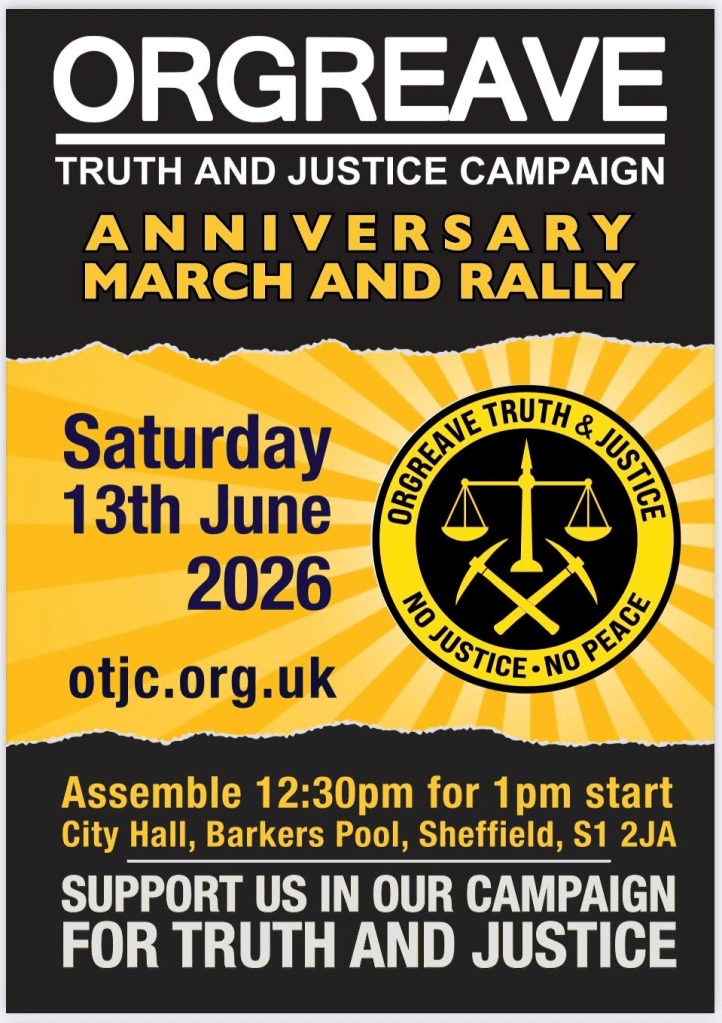
Come along and support the Orgreave Anniversary March and Rally organised by the Orgreave Truth and Justice Campaign.
- Saturday 13th June 2026
- Assemble 12.30pm for 1.00pm start
- City Hall, Barkers Pool, Sheffield, S1 2JA
We are commemorating the 42nd anniversary of the police riot at Orgreave and celebrating the great Miners’ Strike of 1984/5.
Since our last anniversary rally an Orgreave Inquiry was announced in July 2025 and launched in March 2026. We now need to make sure the inquiry delivers the truth and justice so long overdue.
Please bring along your banners, placards, family, comrades and friends and march with us through Sheffield and support our call for an inquiry for truth and justice for striking miners brutalised by the state at the Orgreave Coking plant on 18 June 1984.
Speakers:
- Donna McLean – SpyCops Survivor, Writer and Activist (Police Spies Out Of Lives)
- Pete Weatherby KC – Justice Campaigner
- Andrea Egan – UNISON General Secretary
- Gaz Jackson – RMT Regional Organiser, Yorkshire and Lincolnshire
- Sara Choonara – Grassroots Footballer and Community Activist
- John Dunn – ex-miner, Orgreave Truth and Justice Campaign
Music:
- Joe Solo – Musician, Writer, Activist
- UNITE Brass Band – 2025 Yorkshire Regional Champions
- PCS Samba Band – Drumming up support
Compères:
- Chris Peace and Joe Rollin
- Orgreave Truth and Justice Campaign.

